
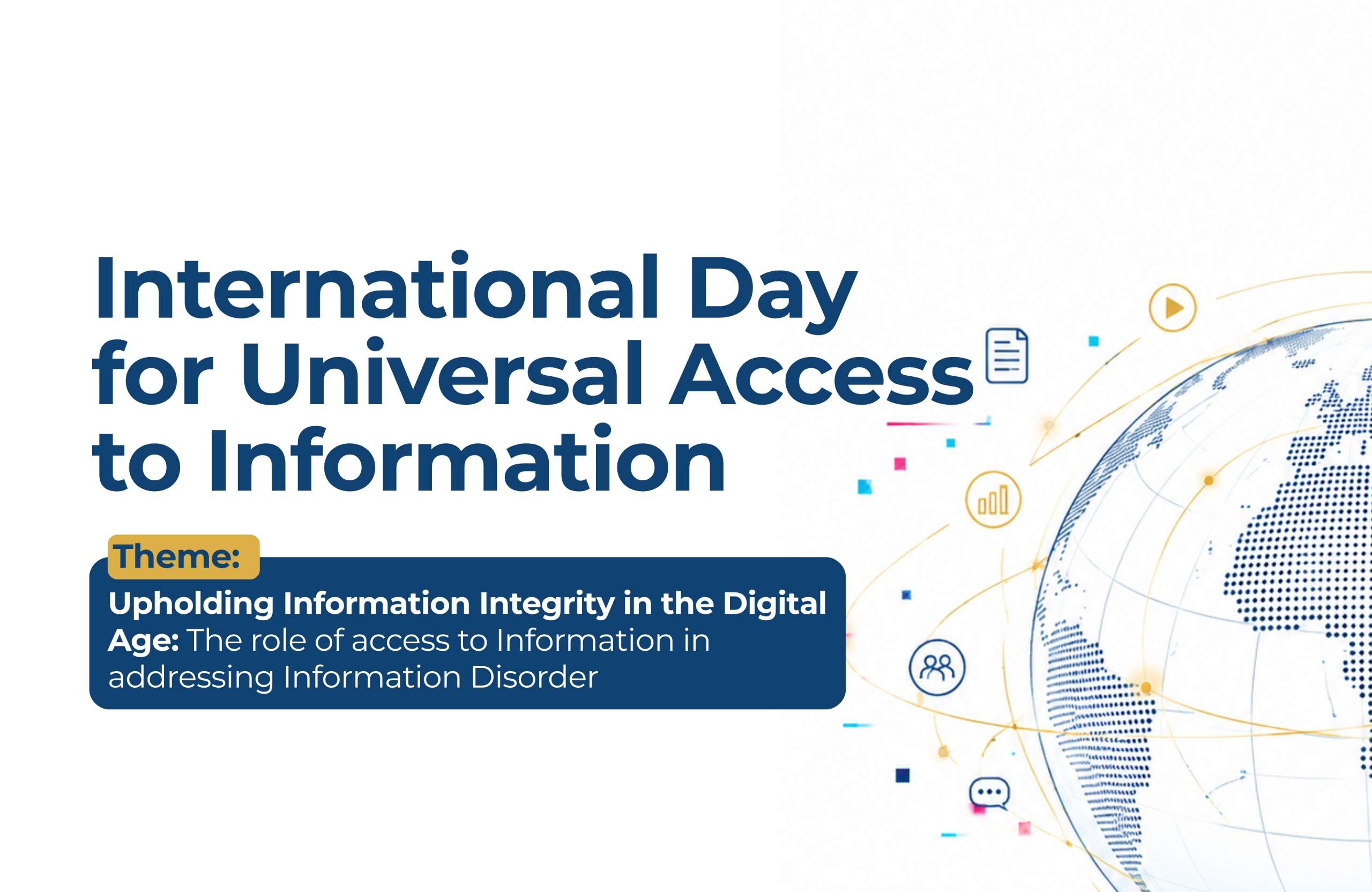
As West Africa hosts the 2026 global commemoration of the International Day for Universal Access to Information, the Media Foundation for West Africa (MFWA) calls on governments across the region to ensure that people’s access to information is not just on paper but in practice.
This year’s commemoration provides a critical opportunity for the sub-region to reflect on the theme: “Upholding Information Integrity in the Digital Age: The Role of Access to Information in Addressing Information Disorder.” The theme highlights the critical role of timely, accurate, and accessible public information in helping citizens navigate an increasingly complex digital information environment.
Across West Africa, false and misleading claims now spread faster than official responses, amplified by social media, coordinated disinformation campaigns and emerging technologies such as deepfakes. When reliable public information is hard to obtain, these claims become harder to challenge. Open access to official records helps journalists and citizens verify claims, scrutinise decisions and take part in informed public debate.
Article 19 of the International Covenant on Civil and Political Rights and Article 9 of the African Charter on Human and Peoples’ Rights protect the right to seek and receive information. The African Commission’s 2019 Declaration of Principles on Freedom of Expression and Access to Information in Africa provides further guidance, including on proactive disclosure, and Sustainable Development Goal 16.10 recognises access to information. These commitments matter most when falsehoods spread quickly: proactive disclosure puts verifiable facts in the public domain before rumour fills the gap.
In West Africa, however, this right remains difficult to exercise given the shrinking civic space. Although Liberia is the first West African country to enact the access to information law, its implementation is impeded by denials of access to information, with journalists complaining about a lack of compliance with the law. The story is not different in Sierra Leone and Nigeria. Ghana’s Right to Information regime is largely effective but institutional red tapes including delays in releasing information, unjustified refusals and excessive fees still remain a challenge.
Additionally, access to information in the Sahelian countries continues to be a major hurdle for freedom of expression and citizen’s right to transparent and accountable governance.
These challenges notwithstanding, some newsrooms across the sub-region are producing impactful journalistic work, using access to information laws after the MFWA’s training programmes. For instance, the MFWA’s public-interest and accountability journalism project, The Fourth Estate, used the Right to Information (RTI) Act for investigative work with far-reaching impact. The government of Ghana ordered investigations into the procurement method for multi-billion dollar road contracts. More than 500 public officers, including ministers, parliamentarians and judges, were compelled to declare their assets and liabilities; the government enacted a new scholarship law to ensure transparency and accountability in the administration of government scholarships, and the government revoked a mining law that opened up Ghana’s forest reserves to politically exposed persons.
In addition to the training programmmes on access to information, the MFWA also empowered journalists on information integrity. Between March 2025 and January 2026, we partnered the ECOWAS Commission and the German Development Cooperation (GIZ), and trained 500 journalists, editors and media managers from 12 West African countries in fact-checking, digital verification, ethical journalism and the responsible use of emerging technologies. The training also built cross-border collaboration among journalists, because disinformation rarely respects national boundaries.
In Guinea-Bissau, with support from the European Union, we trained 60 journalists and media managers from 10 major media organisations, as well as 35 social media influencers, in fact-checking and media and information literacy. The literacy materials were produced in Portuguese, Creole, Balanta and Fula, reaching an estimated 1.5 million people with reliable information in languages they understand. We further worked with Reporters Without Borders (RSF) and Fondation Hirondelle (FH) under an 18-month European Union-funded project to promote and protect democracy by safeguarding freedom of opinion and expression and combating mis/disinformation in Guinea-Bissau.
As we mark IDUAI 2026, we emphasise that information integrity cannot be achieved by content moderation alone. It requires transparent institutions, timely access to authoritative information, and a media that is free and equipped to verify and report accurately.
We therefore call on West African governments to:
- Enact comprehensive access to information laws wherever they are lacking, consistent with regional and international standards.
- Enforce existing access to information laws, with clear deadlines, affordable procedures, narrowly defined exemptions, independent oversight and effective remedies for non-compliance.
- Proactively publish public information, including budgets, contracts, procurement decisions, public expenditure and other records of high public interest in accessible, searchable formats.
- Resource information commissions and public institutions to manage requests effectively, and train public officials to treat disclosure as a duty of service.
- Invest in digital storage systems that make information retrieval more efficient.
- Protect journalists and the public who seek information in the public interest, and support media and information literacy to help people assess and verify information.
- Where journalists require clarifications on information, public officials should make themselves available and provide timely and accurate responses to prevent the spread of misinformation
The MFWA reaffirms its commitment to defending press freedom, promoting information integrity, and advancing universal access to information as parts of the bedrock of democracy and development in our region.