
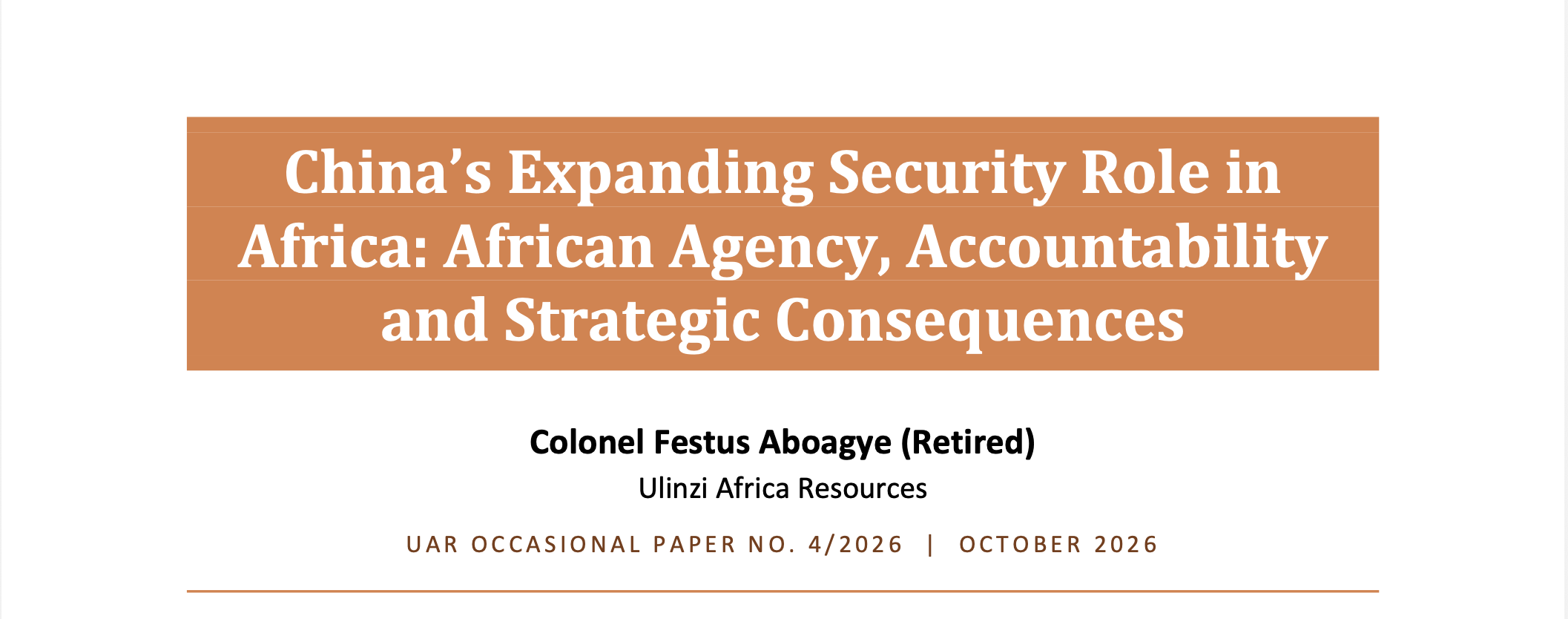
China has become a major security actor in Africa within a single generation, while the oversight systems surrounding that relationship have not kept pace.
This paper by Col. Festus Aboagye (Retired) traces the development of the security dimension of China–Africa relations, examines the bundled model through which it operates, and reviews evidence on arms transfers, training, military exercises and policy commitments, with particular attention to West Africa and the Sahel. The paper weighs the opportunities for African states against seven categories of risk, from procurement lock-in and digital surveillance to strategic entanglement.
Col. Aboagye argues that the central vulnerability is not military domination but an accountability deficit that can deepen over time. The paper proposes assessing external security partnerships comparatively, by their terms, transparency, and outcomes rather than by the flag attached to them.
He defines strategic agency as the capacity not only to choose among partners but also to scrutinise, alter or exit those relationships. Where external conditionality is limited, the burden of oversight falls more heavily on domestic institutions, including parliaments, audit bodies, courts, civil society and the media. Investigative journalism is therefore treated as part of security governance rather than simply as commentary on it.
The paper concludes with recommendations for governments, parliaments, regional organisations, civil society and the media aimed at strengthening accountability while preserving the benefits of diversified security partnerships.
Colonel Festus Aboagye (Retired), is a career infantry officer, peacekeeping practitioner and scholar with nearly five decades of experience in African peace and security.
Read and download the full paper below.
Loading Viewer...
Access File