

The Media Foundation for West Africa (MFWA) has launched the tenth edition of its Next Generation Investigative Journalism (NGIJ) Fellowship, welcoming ten young professionals selected to strengthen their skills in investigative and accountability journalism.
The three-month Fellowship, running from September to November 2026, was officially opened on Tuesday, 8 September 2026, at MFWA’s office in Accra. The new cohort comprises seven women and three men with diverse professional backgrounds spanning online, radio and television journalism, data analytics, computer science and climate change.
The diversity of the cohort reflects the Fellowship’s evolving approach to investigative journalism training, which seeks to bring together journalists and professionals from different fields who have a strong interest in public-interest and accountability reporting.
Speaking at the opening ceremony, Dr. Kojo Impraim, Director of Media for Democracy and Good Governance at MFWA, encouraged the fellows to take full advantage of the opportunity and commit to the standards expected of investigative journalists.

He noted that the Fellowship goes beyond developing investigative skills, providing fellows with practical tools to become influential voices capable of contributing to public discourse, advocating for change and influencing policy.
“Integrity, curiosity, resilience, and courage must form the backbone of your investigative work,” Dr. Impraim urged the fellows, stressing the importance of producing journalism that serves the public interest and holds power to account.
Mr. Kweku Lartey Obeng, Component Manager, PAIReD Programme at GIZ, reaffirmed the programme’s commitment to the NGIJ Fellowship and its role in nurturing future investigative journalists.
“Ask difficult questions, be curious and most importantly, put in the work. The value of this fellowship will be visible at the end of the three months. It will be seen years from now in the stories you produce, in the newsrooms you lead, and the issues you bring to the public attention and accountability you continue to demand throughout your careers,” Mr. Obeng said.

The Fellowship forms part of activities being implemented by MFWA under the project titled “Countering Corruption Through Accountability Journalism and Improved Freedom of Expression Environment in Ghana”. The project falls under the Participation, Accountability and Integrity for a Resilient Democracy (PAIReD) programme, commissioned by the German Federal Ministry for Economic Cooperation and Development (BMZ), co-financed by the European Union and the Swiss State Secretariat for Economic Affairs (SECO), and implemented by GIZ in cooperation with Ghana’s Ministry of Finance.
Building the Next Generation of Accountability Journalists
The tenth edition continues MFWA’s commitment to strengthening accountability journalism and building the next generation of investigative journalists in Ghana.
The Fellowship will provide training in investigative journalism, fact-checking, data journalism, mobile journalism, the use of Ghana’s Right to Information (RTI) law, policy influencing, digital and physical safety, AI and journalism, and reporting on gender dimensions of corruption. Fellows will also receive training in grant writing and grant sourcing to help sustain investigative and accountability reporting beyond the Fellowship.
The Fellowship will combine classroom-based training with mentorship, practical investigations, field and institutional visits, editorial support and story production. Fellows will work with experienced journalists, including those at The Fourth Estate, to develop and refine their story ideas and investigative skills.
Meet the Tenth Cohort
The ten fellows selected for the tenth edition bring diverse professional experiences and perspectives to the Fellowship. Their backgrounds include journalism, data analysis, computer science, and environmental and climate-related fields.
Fellow Profiles
Abigail Owusu Ahimah
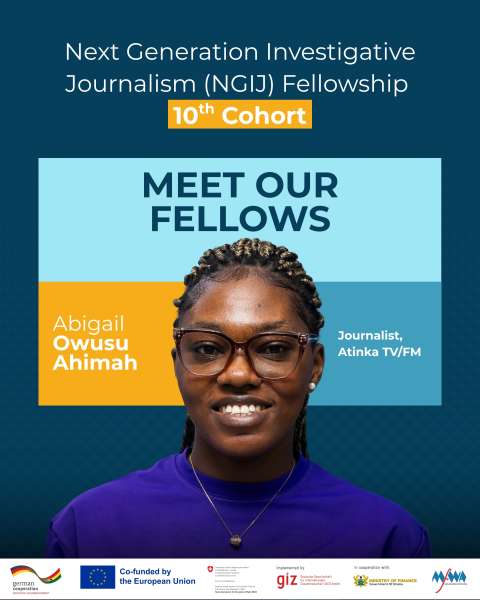
Abigail Owusu Ahimah is an alumna of the University of Media, Arts and Communication and an early-career journalist with Atinka TV/FM. She has nearly seven years of experience working as a reporter, producer, news anchor and news bulletin editor.
Abigail believes journalism goes beyond reporting events. For her, journalism is about asking the right questions, seeking the truth and giving people a voice.
She is particularly interested in developing specialised investigative journalism skills in research, data analysis, fact-checking and the effective use of the Right to Information law.
Through the NGIJ Fellowship, Abigail hopes to strengthen her ability to use data to uncover stories, improve her fact-checking skills and produce impactful journalism that promotes accountability. She also looks forward to learning from experienced journalists while developing the confidence, competence and ethical discipline required for investigative reporting.
Sandra Naa Ayikailey Ayikwei
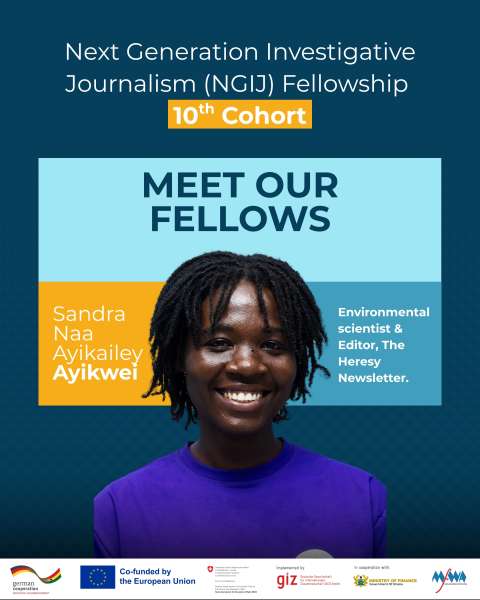
Sandra Naa Ayikailey Ayikwei is an environmental scientist based in Ghana, with a focus on marine pollution and waste prevention, air quality and atmospheric pollution in the Greater Accra Metropolitan Area.
She serves as a mentor and reviewer with the Earth Foundation, supporting emerging researchers and innovators working on environmental and climate issues globally.
Sandra also runs The Heresy, an independent newsletter examining climate, governance and environmental policy in Ghana. Her work takes a data-driven and accountability-focused approach to issues including energy transition, climate finance and climate justice.
Through the NGIJ Fellowship, Sandra hopes to strengthen her investigative journalism skills and move beyond producing investigative pieces to developing stories that generate deeper public engagement and action.
She sees the Fellowship as an opportunity to sharpen her craft as an editor and aspiring journalist while bringing her environmental expertise into public-interest and accountability journalism.
Edwin Gogu
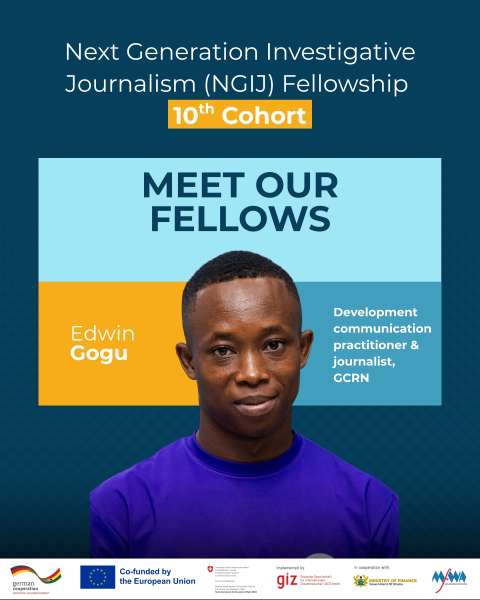
Edwin Gogu is a development communication practitioner, journalist and community development professional with more than six years of experience in radio broadcasting, journalism, community engagement, research, project management and strategic communications.
He currently works as a Programmes Officer with the Ghana Community Radio Network (GCRN) and as a programme host and reporter for PAD FM 95.1 in Damongo.
His professional experience spans community development, governance, agriculture, agroecology, youth empowerment, gender equity, environmental sustainability, and social and behavioural change communication.
Edwin holds a Bachelor of Science degree in Social Change Communication from the University for Development Studies and is currently pursuing an MPhil in Development Management at the University for Business and Integrated Development Studies (UBIDS) under the WAC-SRT/DAAD Scholarship.
Passionate about journalism for the public good, Edwin is interested in using fact-based journalism to give voice to marginalised communities and promote accountability and sustainable development.
Regina Deladem Kevi
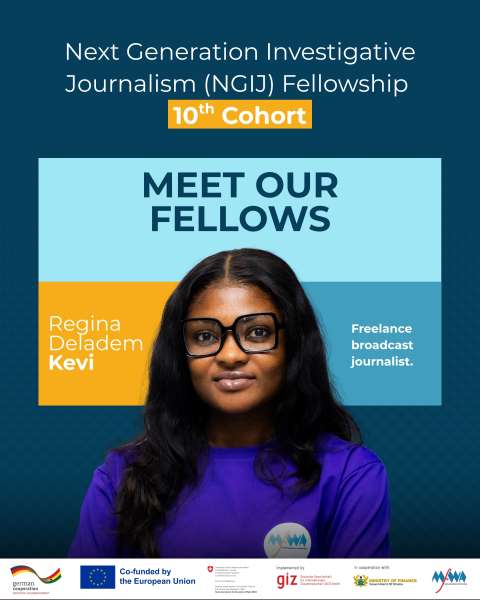
Regina Deladem Kevi is a freelance broadcast journalist based in Accra and a Level 400 broadcast journalism student at the University of Media, Arts and Communication – Institute of Film and Television (UniMAC-IFT).
She is passionate about investigative and accountability journalism and uses storytelling to highlight issues affecting ordinary people and amplify underrepresented voices.
Through the NGIJ Fellowship, Regina hopes to sharpen her investigative reporting skills, learn from experienced mentors and produce impactful stories that advance transparency, accountability and justice.
Her areas of interest include health, climate and governance, where she hopes to use investigative journalism to bring important public-interest issues to greater attention.
Zita Okwang
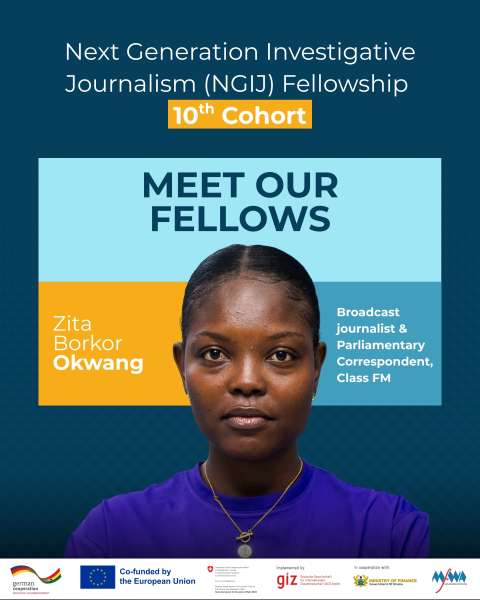
Zita Okwang is a broadcast journalist with more than eight years of experience in news anchoring, field reporting, digital journalism and the production of prime-time news bulletins at Class FM.
As a Parliamentary Correspondent, she reports on legislative developments and helps audiences understand how decisions taken in Parliament affect their everyday lives.
Zita is passionate about telling stories that matter, particularly those that expose gaps in governance, amplify overlooked voices and bring public-interest issues to the attention of decision-makers.
Through the NGIJ Fellowship, she hopes to deepen her investigative reporting skills and develop a more rigorous approach to uncovering complex issues.
She aims to produce compelling, evidence-based stories that go beyond the headlines, question systems and hold people entrusted with public responsibility accountable.
Richard Agodzo
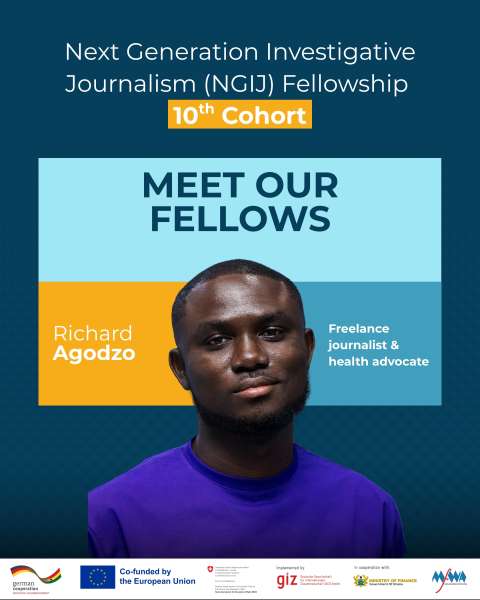
Richard Agodzo is a freelance journalist, health advocate and storyteller whose journalism career began at the Graphic Communications Group Limited.
His work has evolved to focus on the intersection of gender, digital health and human rights, using journalism and advocacy to draw public attention to issues affecting individuals and communities.
Richard currently leads GENT+ Network, an advocacy network dedicated to advancing men’s health, wellness, rights and inclusion. Through his blog, AGODZO WRITES, he explores issues relating to society, human rights, health and everyday realities through storytelling and analysis.
His work seeks to amplify unheard voices, challenge injustice and encourage deeper reflection on issues affecting people both online and offline.
Richard is interested in investigative journalism that goes beyond headlines to uncover hidden truths, hold power accountable and centre the voices of affected communities.
Through the NGIJ Fellowship, he hopes to strengthen his use of digital tools, evidence and human-centred reporting to produce journalism that exposes injustice and contributes to meaningful change.
Abigail Teye
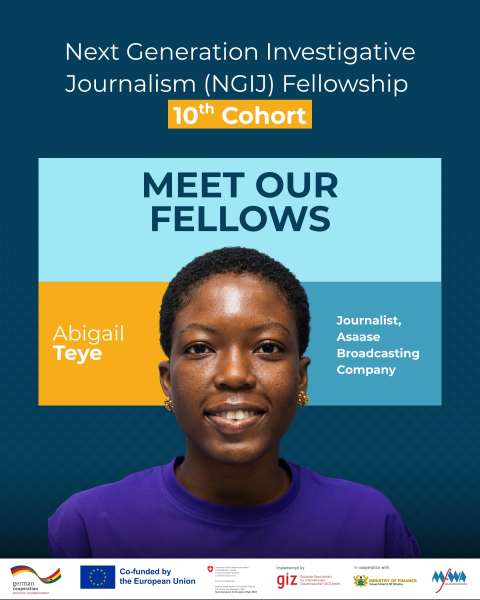
Abigail Teye is a journalist with Asaase Broadcasting Company Limited, Ghana. Her reporting covers climate change, environmental sustainability, governance, development, business, social issues and other matters of public interest.
Her work reflects a strong interest in telling stories that examine issues affecting society while making complex subjects accessible and relevant to everyday audiences.
Abigail is passionate about public-interest journalism, particularly climate and development reporting. She believes journalism can inform the public, amplify important conversations, hold institutions accountable and contribute to meaningful change.
Through the NGIJ Fellowship, she hopes to strengthen her investigative reporting skills and deepen her understanding of anti-corruption and accountability reporting.
She aims to produce rigorous, evidence-based stories that promote public accountability, encourage informed public discourse and contribute to better governance.
Seth Abbey
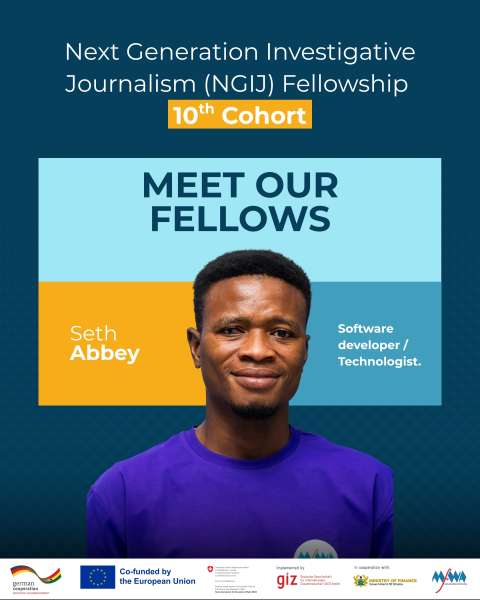
Seth Abbey is a Ghanaian technology enthusiast and software developer with a background in Computer Science. He is passionate about using technology, data and digital tools to solve real-world problems and tell stories that create social impact. His interests include technology, digital rights, accountability, development and using data to uncover issues affecting communities.
Through the NGIJ Fellowship, Seth hopes to strengthen his skills in investigative reporting, data journalism and storytelling. He aims to combine technology and journalism to investigate important issues, promote accountability and contribute to positive change in Ghana.
Peace Vordzorgbe
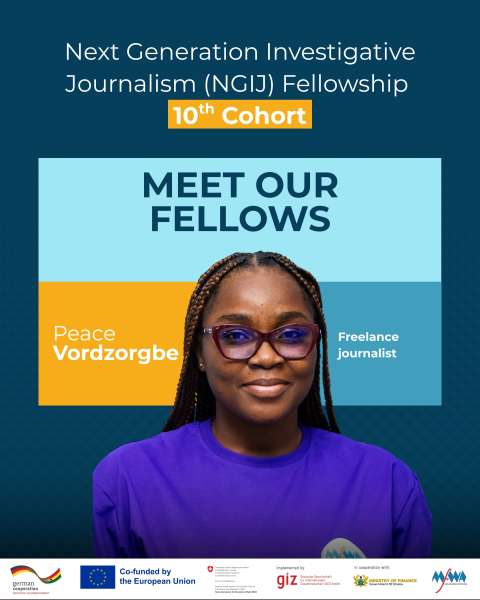
Peace Vordzorgbe is a freelance journalist and an MPhil student in the Department of Journalism and Media Studies at the University of Education, Winneba. A development communicator, she previously served as a Teaching Assistant in the department during her national service and gained practical newsroom experience through an internship with JoyNews.
Her interests include public-interest, investigative and accountability journalism. Through the NGIJ Fellowship, Peace hopes to sharpen her investigative reporting skills, strengthen her proficiency in fact-checking and verification tools, and learn from experienced journalists and mentors. She aims to use these skills to produce credible, evidence-based stories that promote accountability and serve the public interest.
Rahmatu Umar Bukari
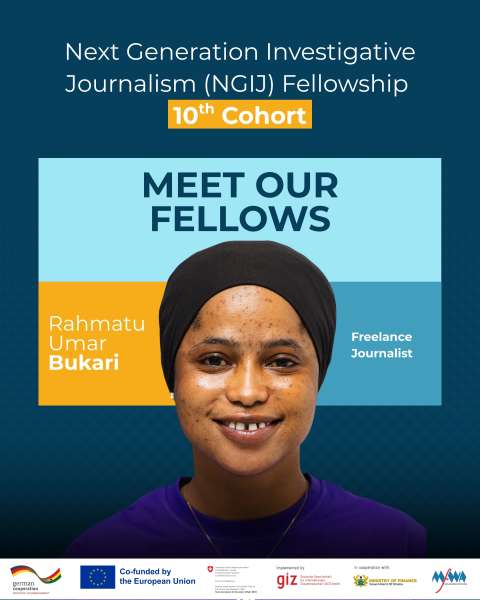
Rahmatu Umar Bukari is a journalist with a BA in Communication Studies (Journalism specialization) and a Diploma in Communication Studies, both from UniMAC-IJ. She gained experience in TV news reporting, news writing, interviews, feature writing, and event coverage at the Ghana Broadcasting Corporation (GBC).
She’s driven by accurate, balanced, impactful storytelling and has a growing interest in investigative journalism. Now pursuing freelance work, she’s applying for MFWA’s NGIJ Fellowship to build investigative skills, specifically the ability to uncover facts, ask hard questions, and produce stories that drive meaningful change.