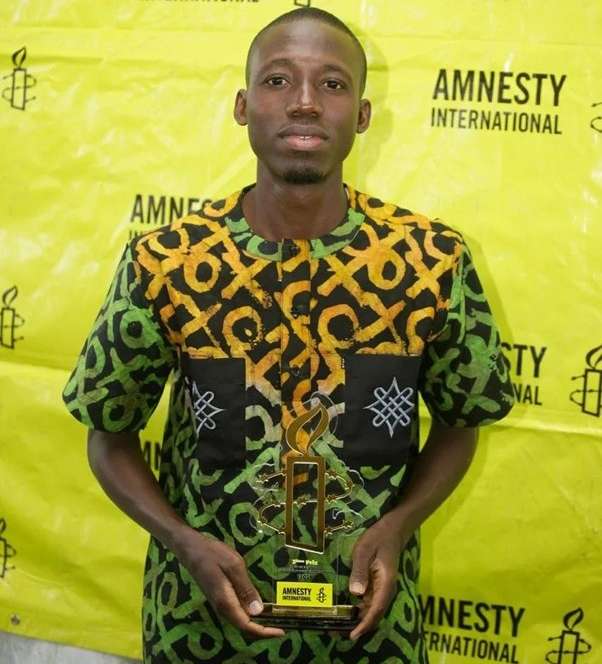


In 2023, Alfred Koroma, a print journalist with Concord Times Newspaper and a member of the first cohort of our Digital Public Infrastructure (DPI) Journalism Fellowship, asked a question many mobile money users had never asked: what happens to mobile money accounts when their owners die?
Alfred’s investigation found that customers had no way to name a next of kin on their accounts. His report, titled “The Untold Story of Mobile Money Accounts: What Happens When Users Pass Away?”, was produced during the maiden edition of the DPI Journalism Fellowship funded by Co-Develop.
Examining the two providers Orange Money and Afrimoney, Alfred’s investigation revealed gaps in regulation, unclear next-of-kin protocols, and the financial hardship faced by families unable to access the digital assets of deceased relatives.
“Many people don’t even know what happens to their accounts when they die,” Alfred said at the time. “There are no clear policies to protect families.”
When Alfred put the question to Afrimoney, Robert Charles, the company’s Communications Supervisor, acknowledged the importance of the issue, noting that next-of-kin protocols had never really been on the company’s radar. He said the matter needed to be considered and addressed.
On 11 August 2026, three years after Alfred’s report, Afrimoney launched a Next-of-Kin Service, which allows subscribers to nominate a person to be contacted about their accounts in the event of death or incapacity. Subscribers register by dialling *161*8*6#.
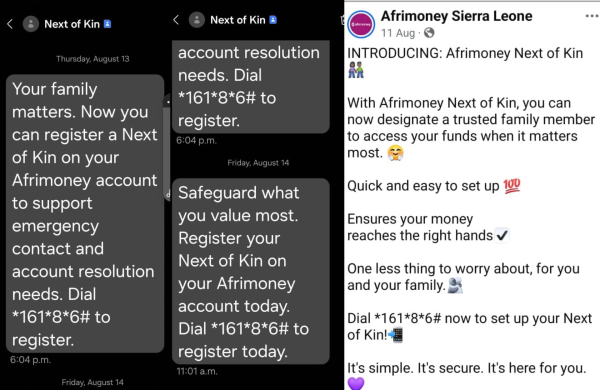
“This is encouraging to see, as the issue highlighted through the investigation is now being addressed through a practical service,” Alfred said. “I’m grateful to the DPI Journalism Fellowship for supporting the investigation and providing the opportunity to pursue stories that can contribute to positive change,” he added.
Recognition at the SLAJ National Media Awards
Alfred’s reporting earned national recognition at the Sierra Leone Association of Journalists (SLAJ) 2024/2025 National Media Awards, where he emerged as one of the night’s biggest winners with four awards.
His mobile money investigation was one of three winning stories, alongside one on child labour in fishing villages and another on climate devastation in rice-growing communities in Sierra Leone. He was also named Print Media Journalist of the Year.
Alfred credits the DPI Fellowship with changing how he approaches journalism.
“Before the Fellowship, I found it challenging to write in-depth stories. But through the programme, I gained the skills to analyse digital systems and frame complex DPI issues in a human-centred way,” he said. “I also improved my interviewing techniques and storytelling tools, which helped me make technical issues relatable to everyday people.”
About the DPI Fellowship
The Digital Public Infrastructure (DPI) Journalism Fellowship is a project of the Media Foundation for West Africa (MFWA), with funding support from and in partnership with Co-Develop. The project seeks to empower media professionals with the knowledge and skills necessary to contribute effectively to the evolving digital landscape, ensuring that the benefits of DPI are widely understood and leveraged across West Africa.
Specifically, the project trains competitively selected journalists from across West Africa on the concepts of DPI and Digital Public Goods (DPGs). The Fellowship also prepares the beneficiaries to better understand and produce stories that elevate public awareness, stimulate debates, foster inclusivity, demand accountability and encourage participation and uptake of DPI across West Africa.
Since its inception in 2023, the DPI Journalism Fellowship has trained 80 journalists from 10 West African countries. Collectively, the DPI Fellows have produced over 370 stories on digital IDs, digital payment systems, data exchanges and other digital transformation processes.
Through the Fellowship, we and our partners are nurturing journalists who help ensure that digital progress benefits everyone and advances good governance across the region.