
Introduction
A free, independent, and professional media is essential for democratic governance, accountability, and informed citizen participation. In today’s rapidly evolving information ecosystem, journalists are expected to build capacities in emerging fields within journalism. These include strengthening capacities in conflict reporting, digital skills, countering disinformation, fact-checking, investigative journalism, media ethics, gender-sensitive reporting, artificial intelligence (AI) and the integration of other emerging technologies in news production.
However, there is growing concern that existing journalism and mass communication curricula in Ghana may not sufficiently equip graduates with the practical, ethical, and technical competencies required to meet these demands. Key areas such as digital journalism, fact-checking, conflict-sensitive reporting, investigative journalism, media ethics, and the application of AI in newsrooms are increasingly critical, but may be underrepresented or inconsistently taught.
To address this gap, the Media Foundation for West Africa (MFWA), with support from the European Union through International Media Support, seeks to engage a qualified research consultant to conduct a comprehensive study to analyse the gaps in journalism and mass communication curricula in Ghana. The findings will generate evidence to inform curriculum reform that aligns with industry needs and global media trends. The curriculum reform is expected to strengthen the capacity of journalists to operate effectively in a dynamic media landscape.
This activity forms part of the project titled: “African Media Integrity and Resilience Programme.” The project aims to strengthen the resilience and integrity of independent media, enabling it to act as a pillar of democracy, peace, and sustainable development.
Purpose of the Assignment
The research consultant will conduct an in-depth study that analyses the current state of journalism and mass communication curricula in Ghana, with a focus on identifying gaps, emerging industry needs, global media trends and opportunities for reform.
The study will provide evidence-based recommendations to support curriculum development that aligns with global best practices, industry demands, and the evolving role of the media in society.
Scope of Work
The research consultant will undertake the following tasks:
A. Curriculum Review and Analysis
i) Conduct a comprehensive review of journalism and mass communication curricula across selected tertiary institutions in Ghana
ii) Analyse course content, structure, and delivery methods
B. The consultant will examine the extent to which the following areas are integrated into curricula:
i) Digital journalism and multimedia storytelling
ii) Fact-checking and misinformation/disinformation
iii) Conflict-sensitive and peace journalism
iv) Gender-sensitive reporting
v) Investigative journalism skills and methodologies
vi) Media ethics and professional standards
vii) Artificial intelligence and emerging technologies in newsrooms
viii) Mobile Journalism
ix) Data journalism
C. Engage key stakeholders to gather insights on skills gaps and training needs of teaching faculty
D. Conduct a comparative analysis to:
i) Compare Ghana’s curricula with regional and global best practices in journalism education
ii) Identify innovative approaches and models that can be adapted locally
E. Gap Identification and Analysis
i) Identify key gaps between academic training and industry expectations
ii) Identify weaknesses in the structure, teaching approach and content
F. Identify structural enablers, barriers and best practice to sustained academia-industry engagements
G. Recommendations for Curriculum Reform
i) Develop practical, actionable recommendation for updating and strengthening curricula
ii) Propose strategies for integrating emerging competencies and industry-relevant skills
Methodology
The research consultant is expected to adopt a rigorous and participatory research approach, which include:
- Desk review of academic curricula, course outlines, and institutional frameworks
- Key informant interviews with journalism training institutions, universities, regulators, policymakers, professional media associations, and other media industry stakeholders
- Interviews or focus group discussions with students and early-career journalists, and media houses
- Comparative analysis with international journalism education standards
- Triangulation of qualitative and quantitative data
The methodology should ensure accuracy, objectivity, inclusiveness, and ethical research practices. All sources, assumptions, and analytical processes must be clearly documented.
Expected Deliverables
The research consultant will be expected to produce:
1. Inception report outlining the research design, methodology, and work plan
2. Draft research report detailing findings from the curriculum analysis and stakeholder consultations
3. Final research report incorporating the team’s feedback and presenting: key findings, identified gaps, and recommendations for curriculum reform
4. Presentation of findings to key stakeholders for inputs
All deliverables must be clear, evidence-based, and suitable for policy and academic use.
Research Consultant Profile
The research consultant should meet the following criteria:
- An advanced degree in Journalism, Mass Communication, Media Studies, Education, or a related field
- At least 7–10 years of relevant experience in media research, journalism education, or curriculum development
- Demonstrated experience in conducting research studies, particularly in education, media, or communication
- Strong understanding of the media landscape in Ghana and globally
- Familiarity with emerging trends in journalism, including digital media, AI, and disinformation
- Excellent analytical, research, and report-writing skills
- Ability to translate complex findings into clear and practical recommendations
- Strong stakeholder engagement and facilitation skills
- High ethical standards and professionalism
Experience working with academic institutions, media organisations, or civil society organisations will be an added advantage.
Duration
The period of engagement will be for a month
The consultant will be required to participate in periodic check-in meetings with the project team
Terms and Conditions
- This is a consultancy engagement, not a full-time employment position
- The consultant will work under the supervision of the MFWA Project Team
- Payment will be made based on agreed milestones and approved deliverables
- The MFWA will retain ownership of all outputs produced under this assignment
- The consultant must adhere to confidentiality and data protection requirements
Application Process
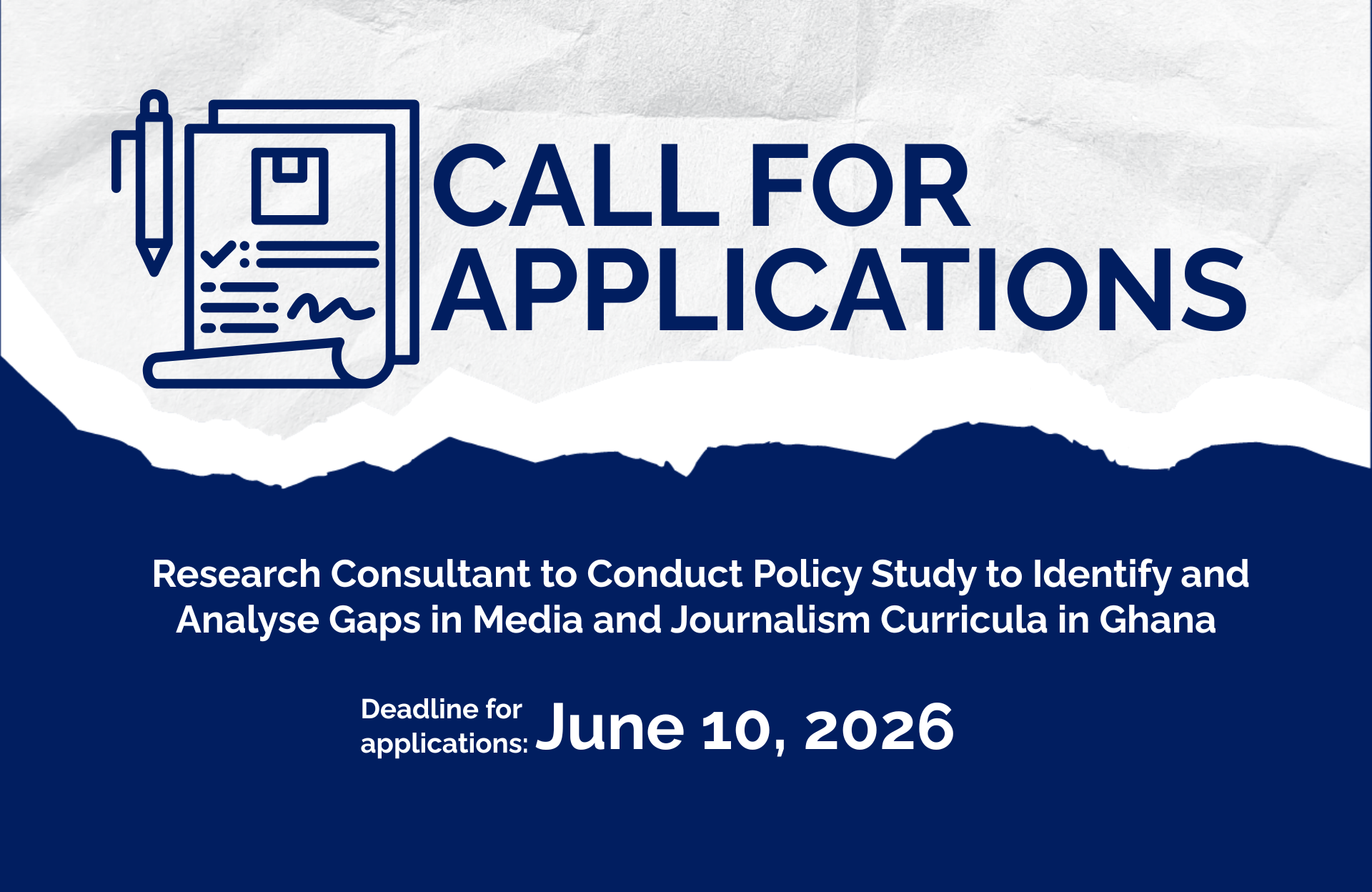
Interested applicants are invited to submit the following documents to [[email protected]] with the subject: Application for Research Study on Media and Journalism Curricula in Ghana by 10th June, 2026.
i) Expression of Interest (EOI) outlining relevant expertise for the assignment
ii) Curriculum Vitae (CV) highlighting qualifications and experience
ii) Technical Proposal (maximum 5–7 pages) including:
- Understanding of the assignment
- Proposed methodology and approach
- Work plan and timeline
- Relevant experience
iv) Financial Proposal indicating consultancy fees
v) Samples of previous research reports or similar assignments (where available)
For enquiries, contact Paul Gozo on 0247756657or [[email protected]] or Fatimata Mustapha on 0244645345 or [[email protected]].
Click the button below to download
Access File