
The Gambia Press Union (GPU), MFWA’s national partner in The Gambia, has intensified its advocacy for democratic media reform by petitioning the African Commission on Human and Peoples’ Rights (ACHPR) to impress on the government to fulfil long-delayed commitments towards media and free expression rights reforms in the country.
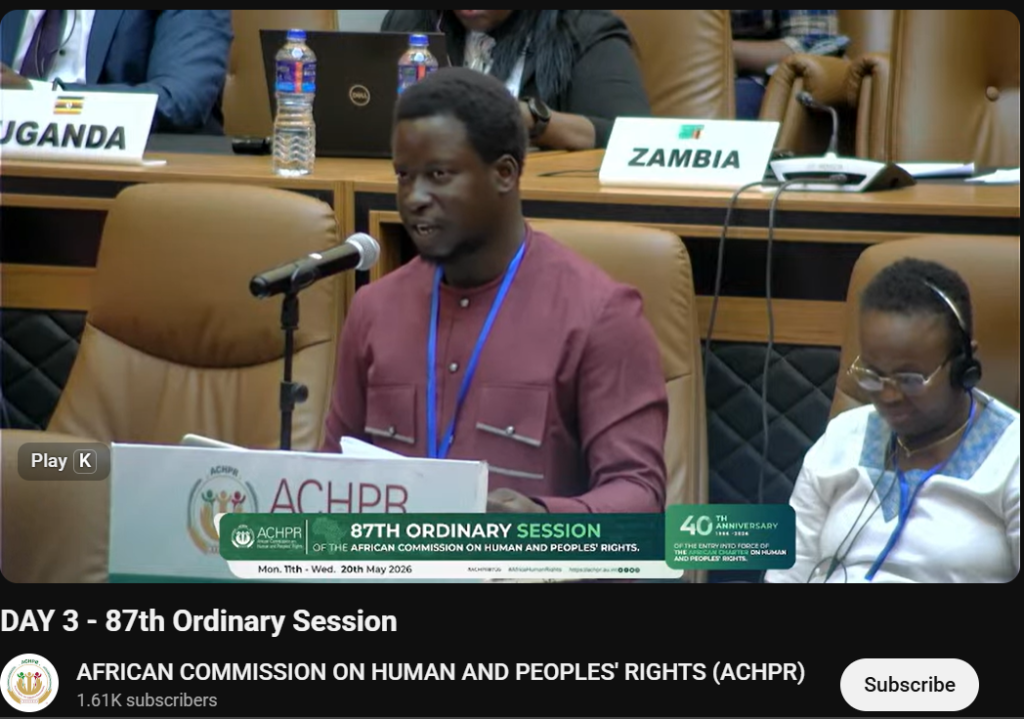
Presenting a statement during the ACHPR’s 87th Ordinary Session in Banjul on 13 May 2026, GPU Secretary General, Mr. Modou S. Joof, urged the Commission to press the Gambian government to expedite critical legal reforms and cease the enactment of new laws that threaten freedom of expression.
The GPU asked the ACHPR to push for parliamentary consideration of its proposals to amend or remove restrictive provisions in the Cybercrime Bill, 2023 and the Communications Bill, 2025. It also renewed calls for the review or repeal of the “False Publication and Broadcasting” offence in the Criminal Offences Act, 2025, and for the full implementation of the Access to Information Act, 2021.
The Union further urged the Commission to demand concrete action to end impunity for attacks on journalists, including ensuring prompt investigations and prosecutions, and to stop the harassment and intimidation of journalists and their sources through arrests and retrogressive legal actions. It also called for the full implementation of the recommendations of the Truth, Reconciliation and Reparations Commission (TRRC) relating to media freedom, independence, pluralism, and the safety of journalists.
While acknowledging The Gambia’s recent improved ranking in the Reporters Without Borders (RSF) World Press Freedom Index —46th globally and 8th in Africa — the GPU stressed that the progress masks enduring structural and legal challenges confronting the media sector.
Speaking in Banjul, Mr. Joof observed that incomplete reform processes and newly proposed laws with restrictive provisions continue to undermine media independence, limit pluralism, and contribute to self-censorship.
He highlighted economic and operational challenges affecting independent media, including: prohibitive taxes and levies on media institutions and imported media equipment, limited state support for private media, growing intolerance of critical reporting by public institutions, and weak implementation of the Access to Information Act.
The GPU documented a series of recent press freedom violations, including physical assaults, nuisance defamation suits, and other acts of intolerance and intimidation targeting critical journalism.
Joof recalled that in 2022, the Gambian government accepted TRRC recommendations to “review or repeal restrictive media laws and replace them with legislation that protects and promotes press freedom and freedom of expression.” He regretted, however, that “while some restrictive laws have been repealed, new laws with similarly restrictive provisions are emerging.”
Among the most concerning is the “False Publication and Broadcasting” provision in the Criminal Offences Act, 2025, which prescribes penalties of up to one year imprisonment, a fine exceeding US$3,000, or both. The GPU noted that the provision has previously been identified for repeal or review by the ECOWAS Court of Justice in 2018, the TRRC in 2021, and the government’s own Media Law Reform Committee in 2018.
The Union also warned that the Cybercrime Bill, 2023, would criminalise vague offenses such as publication of “false news online,” a provision that could be used to undermine legitimate criticism and disagreeable public discourse by journalists, human rights defenders, opposition actors, and ordinary social media users.
In addition, the GPU raised concerns over sweeping surveillance powers contained in the Cybercrime Bill, the Communications Bill, 2025, and the Information and Communication Act, 2009. The Union argued that these provisions lack adequate judicial or independent oversight mechanisms.
Joof specifically warned that Sections 114 to 263 of the Communications Bill, 2025 threaten source confidentiality, editorial independence, and the security of unpublished journalistic materials. He also cautioned that proposed licensing requirements and punitive sanctions contained in the Bill could restrict media diversity and shrink critical civic space.
The GPU further criticised proposed regulatory measures to expand the mandate of the Public Utilities Regulatory Authority (PURA) to include the registration of online news platforms and influential social media users, warning that such measures would impose excessive state control over digital expression.
Through its engagement with the ACHPR, the GPU has reaffirmed its demand for a legal and policy environment that protects freedom of expression, ensures the independence and safety of journalist, and strengthens democratic accountability in The Gambia.