
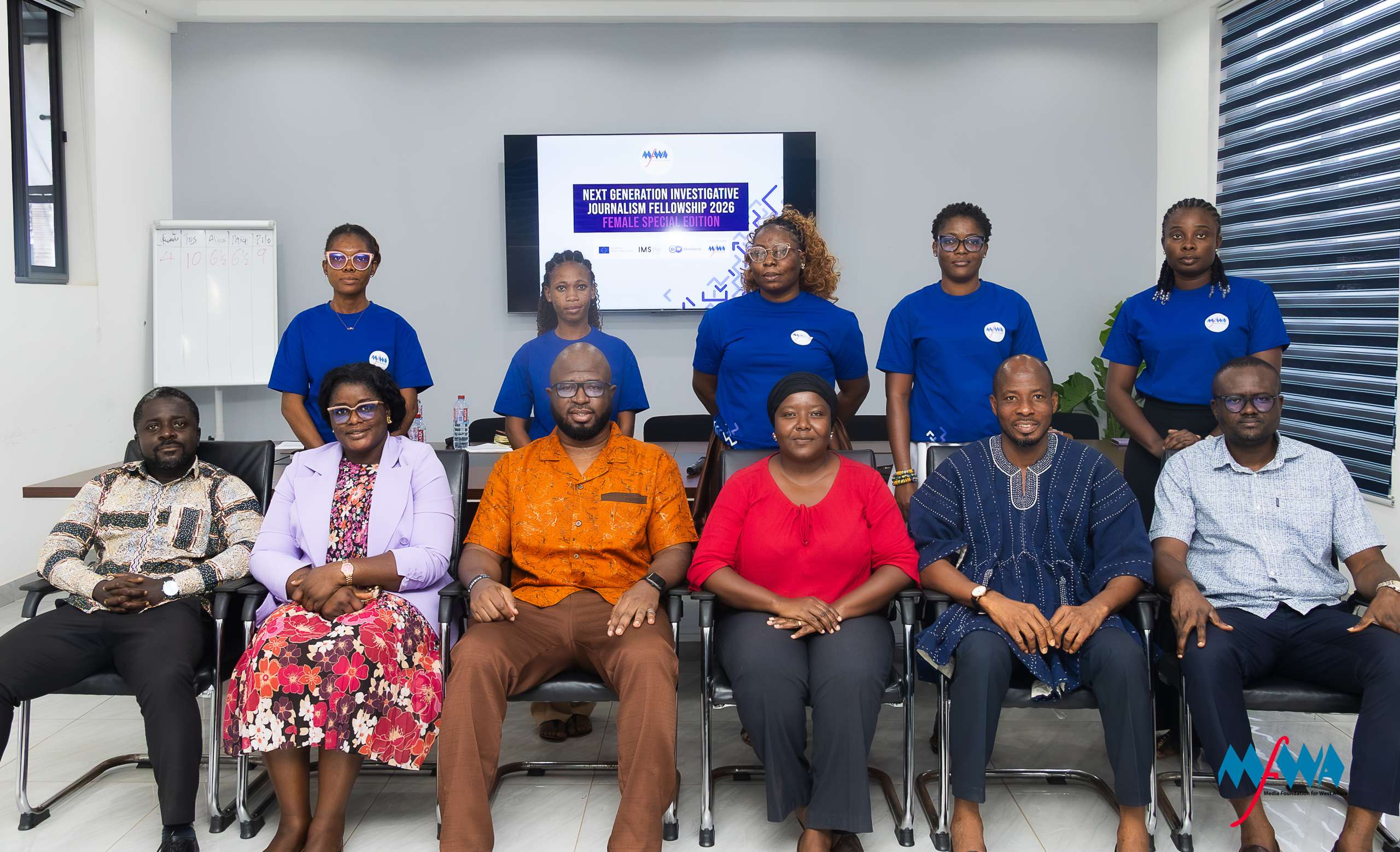
The Media Foundation for West Africa (MFWA) has launched a Female Special Edition of its Next Generation Investigative Journalism (NGIJ) Fellowship to address the persistent underrepresentation of women in investigative journalism in Ghana.
On Tuesday, 4 August 2026, five early-career female journalists were inducted into the twelve-month Fellowship, which runs from August 2026 to July 2027. This special fellowship edition runs alongside, but is separate from, the numbered NGIJ cohort.
The fellowship forms part of the African Media Integrity and Resilience Programme (AMIRP) funded by the European Union (EU) through International Media Support (IMS) and implemented in partnership with DW Akademie.
Throughout the fellowship, the fellows will receive intensive theoretical and practical training, one-on-one mentorship from experienced female journalists and policy experts, and newsroom attachment with The Fourth Estate, our independent accountability journalism project.
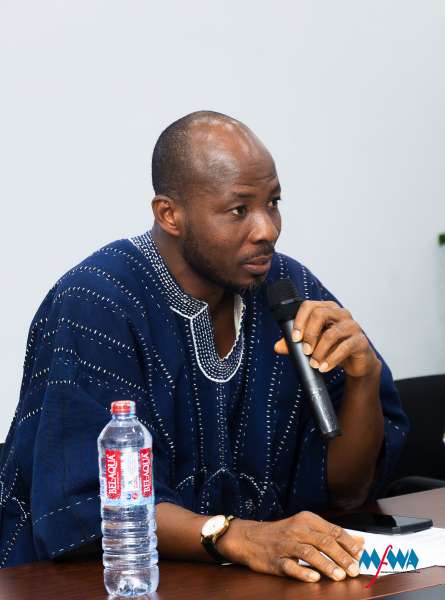
Speaking at the launch, the Director of the Media for Democracy and Good Governance (MDGG) programme at the MFWA, Dr. Kojo Impraim, highlighted the fellowship’s proven impact. Referencing an evaluation of the NGIJ fellowship earlier this year, he noted that the programme has been widely recognised for its practical approach, relevance and ability to build participants’ confidence.
He explained that the fellowship is designed to include coaching on public speaking and policy influencing to develop fellows into influential public voices. “As women in journalism, your voices carry unique strength and perspective. The ability to articulate ideas clearly, engage audiences confidently and influence policymakers is essential for driving societal progress,” he said.
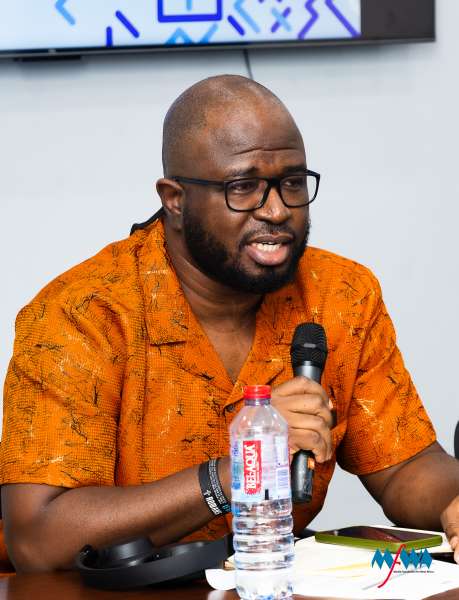
Also addressing the gathering, the Project Manager for AMIRP, Cecil Ato Kwamena Dadzie, reaffirmed the organisation’s commitment to supporting initiatives that create opportunities for women to thrive in investigative journalism.
He emphasised the transformative role of mentorship in professional growth and encouraged the fellows to approach investigative journalism with courage, discipline, confidence and curiosity. “Remember you’re working for the public good. Go out there, hold power to account and make a lasting difference in Ghana and beyond,” he told the fellows.
The fellowship brings together journalists from print, broadcast, television and digital media. Over the priod, each fellow will produce public-interest investigations that amplify women’s perspectives, expose issues of public concern and contribute to evidence-based policy discussions.
Meet the Fellows
Abigail Owarewaa Oware
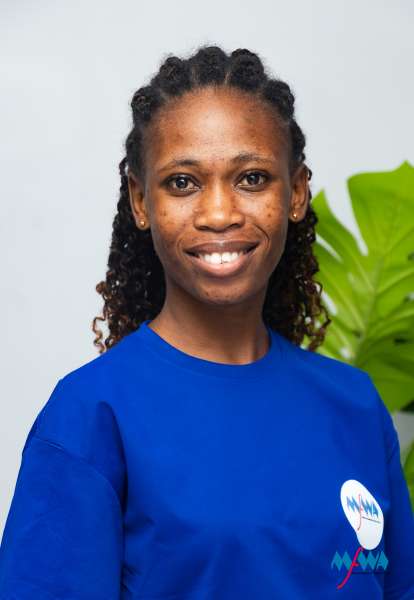
Abigail Owarewaa is a broadcast journalist and reporter with Asaase Radio. An alumna of the University of Media, Arts and Communication (UniMAC) – Institute of Film and Television (formerly NAFTI), she is passionate about public-interest journalism and systemic change. Through the fellowship, Abigail hopes to strengthen her skills in data journalism and digital fact-checking while building the confidence to lead complex investigative projects from conception to publication.
Sandra Agyeiwaa Otoo
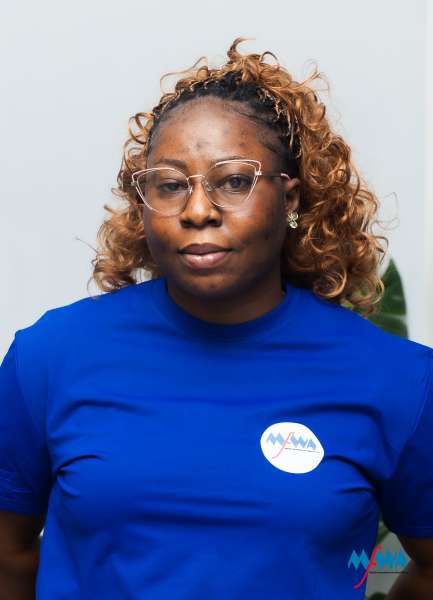
Sandra Agyeiwaa Otoo is a business and investigative journalist with the Business & Financial Times. She reports on business, finance, entrepreneurship, tourism, climate change and environmental sustainability. Sandra sees the fellowship as an opportunity to help bridge the gender gap in investigative journalism by strengthening the capacity of women reporters. She looks forward to learning from experienced female editors and receiving mentorship through The Fourth Estate to produce impactful public-interest investigations.
Abigail Nana Efua Arthur
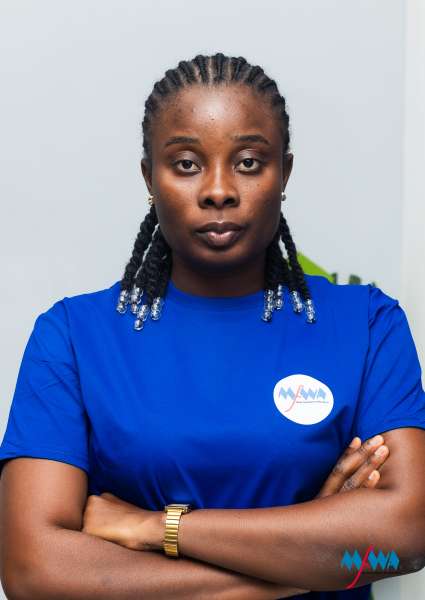
Abigail Nana Efua Arthur is a print and online journalist with extensive experience in news reporting, writing and editing. She holds a master’s degree in Development Communication and a bachelor’s degree in Journalism from UniMAC. As a fellow, Abigail seeks to deepen her skills in investigative and accountability journalism, sharpening her capacity in fact-checking, data journalism, mobile journalism and evidence-based reporting, while producing in-depth stories that advance transparency, good governance and the public interest. She is particularly committed to countering disinformation and championing gender-sensitive, ethical reporting across West Africa.
Shine Esi Kwawukumey

Shine Esi Kwawukumey is a communications professional, journalist, storyteller and founder of Tulips of Herald, a storytelling platform dedicated to publishing stories that inform and impact society. A recipient of the 2024 Future Communicators Foundation Climate Award, Shine uses storytelling and strategic communication to drive advocacy and social change. She hopes to use the fellowship to tell impactful investigative stories that amplify underrepresented voices while promoting accountability and national development.
Mamavi Sephakor Tay

Mamavi Sephakor Tay is a journalist with JoyNews specialising in governance and public accountability reporting. Her work covers public sector reforms, political processes and public policy, with a strong focus on explaining governance issues in ways that are relevant and accessible to citizens. Through the fellowship, Mamavi aims to transition into investigative journalism, particularly in anti-corruption and accountability reporting, enabling her to produce in-depth, evidence-based investigations that strengthen transparency and democratic governance.
About AMIRP
The African Media Integrity and Resilience Programme (AMIRP), covering Ethiopia, Ghana and the Central African Republic, is a multi-year initiative (2026–2028) that seeks to contribute to independent, sustainable and resilient media ecosystems capable of countering misinformation and disinformation. The Female Special Edition of the NGIJ Fellowship seeks to strengthen gender inclusion in investigative journalism by equipping women journalists with the skills, mentorship and professional networks needed to produce high-quality investigative reporting, counter disinformation and promote accountability.