
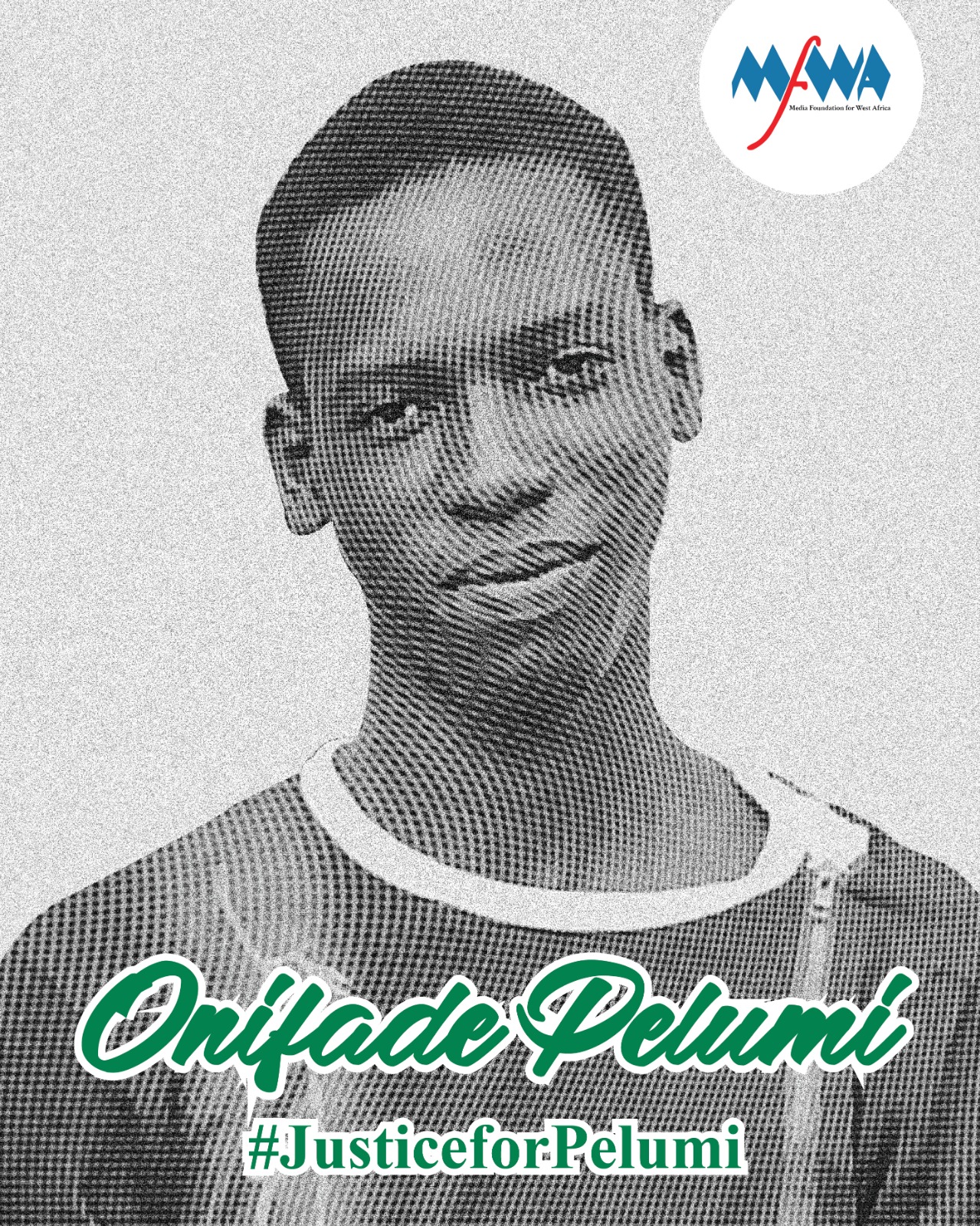
The Media Foundation for West Africa (MFWA) has received with profound sadness the confirmation of death of Pelumi Onifade, the young journalist who disappeared while covering the #EndSARS protests in Lagos in October 2020.
On June 23, 2026, the Lagos State DNA and Forensic Centre presented a sealed report to a Coroner’s court in Lagos confirming that a previously unidentified body, tagged “1385” and deposited at the Ikorodu General Hospital mortuary on November 3, 2020, was that of Onifade. The investigating magistrate said genetic analysis matched the body with a sample provided by the deceased’s mother, Adebose Onifade, establishing her as his mother. The Coroner’s inquest followed a Federal High Court judgment of July 19, 2024, after Nigeria-based free expression organisation, Media Rights Agenda (MRA), filed a suit seeking investigation into Onifade’s death and the prosecution of those responsible.
The confirmation, therefore, ends nearly six years of uncertainty for his family and press freedom advocates and organisations. Pelumi Onifade was a 20-year old history student of Tai Solarin University of Education, who worked as an intern at the online TV station, Gboah TV. He was reportedly arrested on October 24, 2020 by officers attached to the Lagos State Task Force, while covering #EndSARS unrest at a government facility in the Agege area. Witnesses said he was taken away despite wearing a jacket identifying him as a journalist.
Meanwhile, the cause of death and those responsible are yet to be established. The Lagos State University Teaching Hospital (LASUTH) for instance, is yet to submit the autopsy report ordered by the court, which is needed to establish the cause of death. The police have also repeatedly denied any involvement and maintain that Onifade did not die in their custody. The court has adjourned the matter to July 7, 2026.
The MFWA extends its deepest condolences to Onifade’s parents, Olatunde and Adebose Onifade, family, colleagues and the media community in Nigeria.
Pelumi’s case is not isolated as the MFWA has documented other Nigerian journalists killed or disappeared in recent years while passing by or covering protests or simply reporting on stories. Maxwell Nashan, a journalist with the Federal Radio Corporation of Nigeria (FRCN), Adamawa State was found in a bush, tied and muzzled on January 15, 2020 with his body hacked at several places.
Days later, on January 28, 2020, Alex Ogbu, a journalist with the Regent Africa Times newspaper was killed during a security force crackdown against the Shiite Muslim protesters in Abuja. Ogbu was passing by when he was hit by a bullet. A few months after, Tordue Salem, the House of Representatives correspondent for Vanguard, disappeared in Abuja on October 13, 2021 and his remains were recovered on November 11, 2021.
In almost all of these cases, no conclusive investigation has been carried out, and perpetrators are yet to be held to account. While the DNA result of Pelumi Onifade brings a measure of closure, it does not bring justice. The MFWA, therefore, calls on the Lagos State authorities to ensure that LASUTH produces the autopsy report without further delay. The MFWA also calls for the full circumstances of Onifade’s death to be established, and that anyone found responsible is held to account.
The MFWA further urges the Nigerian government to investigate the wider pattern of attacks on and disappearances of journalists during the #EndSARS and subsequent protests, and to end the impunity that has allowed these crimes to go unpunished.