
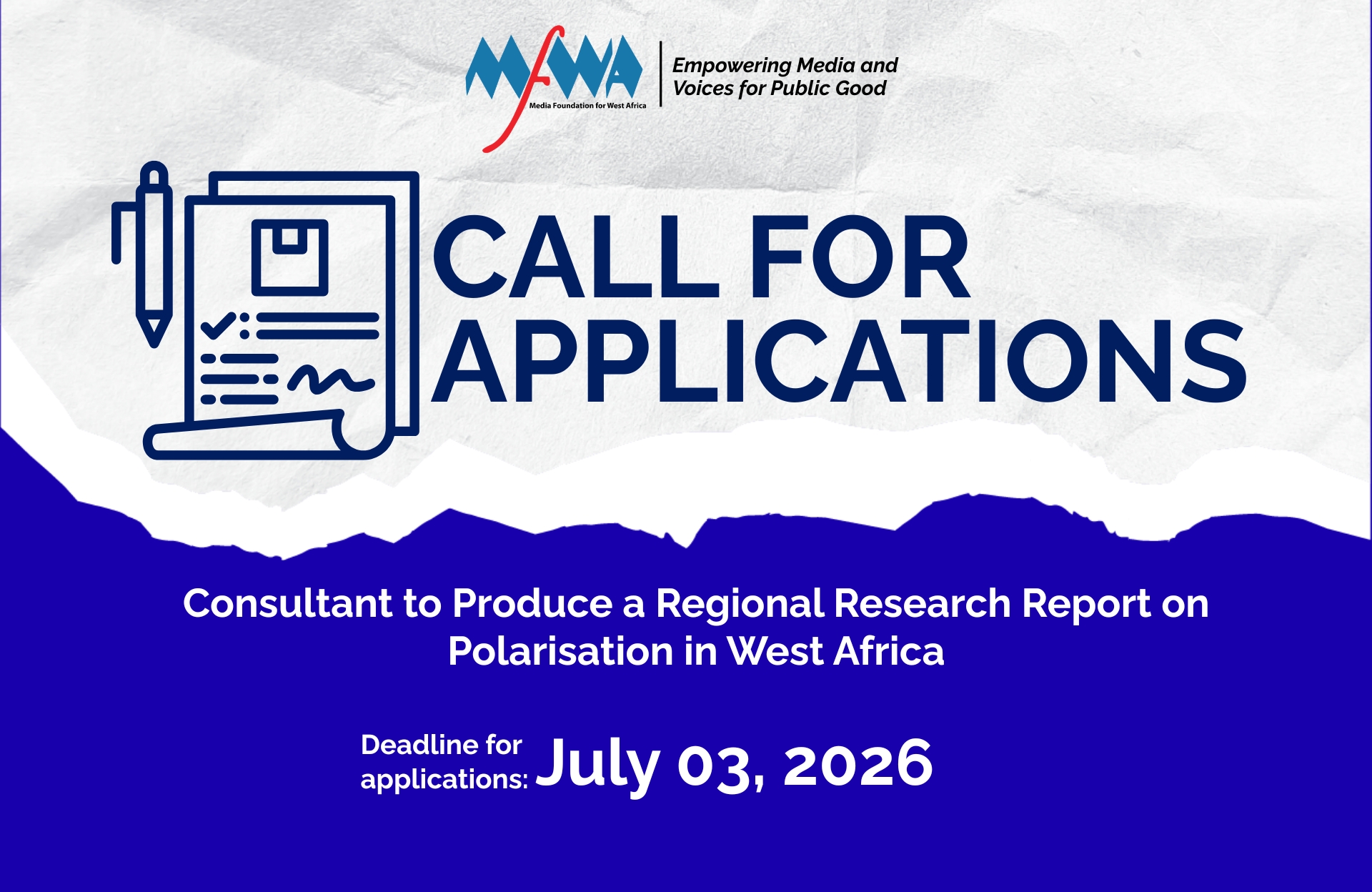
The Media Foundation for West Africa (MFWA) invites applications from experienced and qualified researchers or research teams in Ghana, Nigeria, Senegal, Côte d’Ivoire, Togo and Burkina Faso to undertake a regional study on the state of polarisation in West Africa.
Background
Over the past five years, West Africa has experienced increasing democratic backsliding, political instability, violent extremism, military coups, shrinking civic spaces, and growing social tensions. While these challenges have received considerable attention, the role of polarisation as a key underlying driver has often been overlooked.
Across the region, affective polarisation, where individuals and groups increasingly view those with opposing political, ethnic, religious, or ideological affiliations with hostility and distrust has deepened divisions and weakened social cohesion. This trend has contributed to hardline group loyalties, policy paralysis, democratic erosion, and heightened tensions over political power, economic opportunities, and access to resources. Rapid population growth, youth unemployment, gender-related tensions, and the increasing spread of polarising narratives through traditional and social media have further exacerbated the problem.
Despite its growing impact on peace, democracy, and development, polarisation remains under-researched. There are also limited regional initiatives specifically focused on understanding and addressing the phenomenon.
To help fill this gap, the MFWA is undertaking a regional research project aimed at producing a consolidated regional report that examines the nature, drivers, and manifestations of polarisation across selected countries in the region. The report will provide country-specific analyses and identify key actors contributing to polarisation. The report also seek to offer broad-level recommendations to promote social cohesion and depolarisation.
Scope of Work
Each researcher/research team will conduct research and produce a comprehensive report for the following countries:
• Ghana
• Nigeria
• Senegal
• Côte d’Ivoire
• Togo
• Burkina Faso
For each country, the study should:
• Assess the current state and trends of polarisation in the country.
• Analyse the political, social, economic, cultural, and media-related factors driving polarisation.
• Identify key actors and institutions influencing polarisation dynamics.
• Examine the implications of polarisation for democratic governance, social cohesion, peace, and development.
• Highlight existing initiatives and opportunities for depolarisation.
• Develop practical recommendations for policymakers, civil society organisations, media actors, and other stakeholders.
Deliverables
The selected researcher/research team in each country will be expected to deliver:
1. An inception report detailing the methodology, work plan, and research tools.
2. Country-context analyses for the respective country.
3. A country report on polarisation
4. A presentation of key findings and recommendations to relevant stakeholders.
• All deliverables must be clear, evidence-based, and suitable for policy use. The Consultant/research team is expected to participate in meetings (in-person or virtual) with the project implementation team.
Required Qualifications
Interested applicants should demonstrate:
• Advanced academic qualifications in Political Science, Sociology, Peace and Conflict Studies, Media Studies, Development Studies, or a related field.
• At least 5 years of relevant experience conducting regional or multi-country research in West Africa.
• Strong understanding of governance, democracy, social cohesion, conflict dynamics, and media ecosystems in the region.
• Excellent analytical, writing, and presentation skills.
• Demonstrated ability to produce high-quality research reports within agreed timelines.
• Proficiency in English. Knowledge of French will be an added advantage.
Application Process
Interested applicants should submit:
• A technical proposal outlining their understanding of the assignment, methodology, and work plan.
• A financial proposal indicating consultancy fees.
• A detailed curriculum vitae (CV) highlighting relevant experience.
• Samples of similar research work previously undertaken.
• Contact details of at least two referees.
Location:
The call is open to interested applicants from Africa. Applicants must convincingly demonstrate that they can deliver on the assignment in the selected countries, irrespective of location.
Submission of Applications
Interested individuals or teams should submit their applications no later than 3 July, 2026 to [email protected] with the subject line: [Country eg. Ghana] Application – Consultant for Regional Research Report on Polarisation in West Africa. Kindly copy [[email protected]] in the email.
Applications will be reviewed on a rolling basis, and the process may close once suitable candidates are selected. Only shortlisted candidates will be contacted.
The MFWA reserves the right to accept or reject any application without assigning reasons.