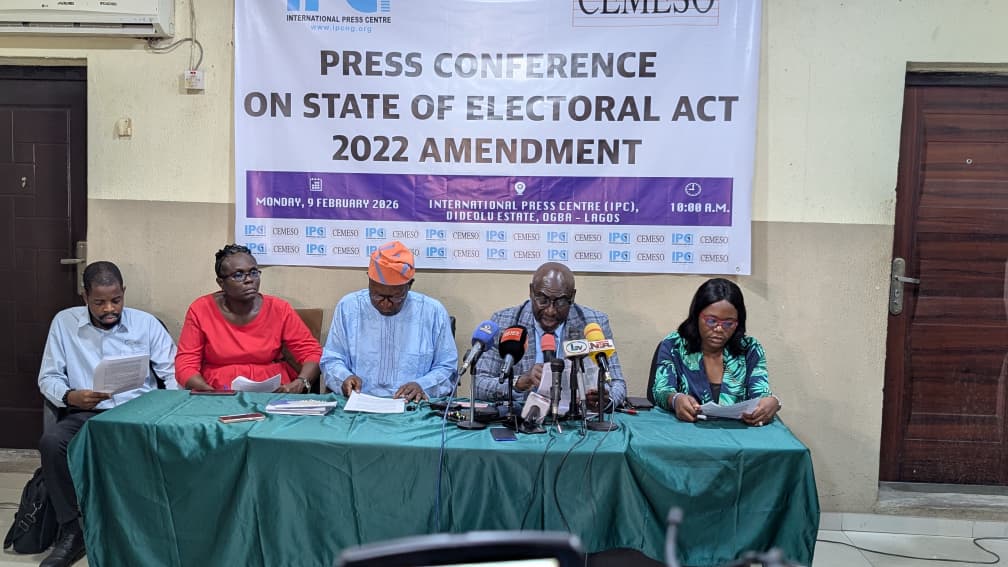
A coalition of leading civil society organizations in Nigeria, including the International Press Center (IPC), country partner of the Media Foundation for West Africa (MFWA), has urged the Harmonisation Committee of the National Assembly to adopt key electoral reform provisions passed by the House of Representatives ahead of the general elections due in 2027.
The Harmonisation Committee comprises members of the two chambers – the Senate and the House of Representatives – that make up the National Assembly, Nigeria’s bicameral legislative arm of government. It is responsible for reconciling differences on a bill that has been passed by both houses.
In a 9th February, 2026 joint statement that the IPC co-signed, stakeholders were warned that recent Senate amendments to the country’s electoral laws could undermine the credibility of the 2027 general elections.
Other members of the coalition include the Centre for Media and Society (CEMESO), The Kukah Centre, International Press Centre (IPC), ElectHer, Nigerian Women Trust Fund, TAF Africa and Yiaga Africa. The rest are Spaces 4 Change, Corporate Accountability and Public Participation Africa (CAPPA) and Women Advocates Research and Documentation Centre (WARDC)
The coalition expressed concern over the Senate’s rejection of key provisions approved by the House of Representatives; including: the electronic transmission of election results, the use of downloadable versions of missing or unissued voter cards for elections, and the shortening of critical electoral timelines. The Senate also removed a proposed 10-year ban for offences related to the buying and selling of Permanent Voter Cards (PVCs).
In the statement, the groups warned that the impasse between the two chambers could undermine the credibility, transparency and integrity of the 2027 general elections. They noted that the protracted amendment process had already created legal uncertainty, and was unduly delaying the preparations of the Independent National Election Commission (INEC); which could compromise its ability to conduct credible elections.
Citing INEC’s established convention of holding general elections on the third Saturday of February in an election year, the coalition noted that the 2027 polls would fall on February 20, requiring the issuance of notice by February 24, 2026. They urged the Harmonisation Committee to mandate the real-time electronic transmission of the election results in a technology-neutral manner, approve the use of downloadable voter cards to prevent voter disenfranchisement, and retain existing timelines for election notices and candidate submissions.
The coalition also called on the INEC to issue the 2027 election timetable without further delay, in accordance with the Electoral Act 2022 and established practice of INEC.
In addition, the coalition recommended broadening the authority to trigger a review of election results beyond INEC officials to include political parties, candidates, agents, and accredited observers, as a way to strengthen transparency and accountability.
They urged lawmakers to prioritise national interest over partisan considerations and conclude the amendment process within two weeks to ensure legal certainty and public confidence in the electoral process.