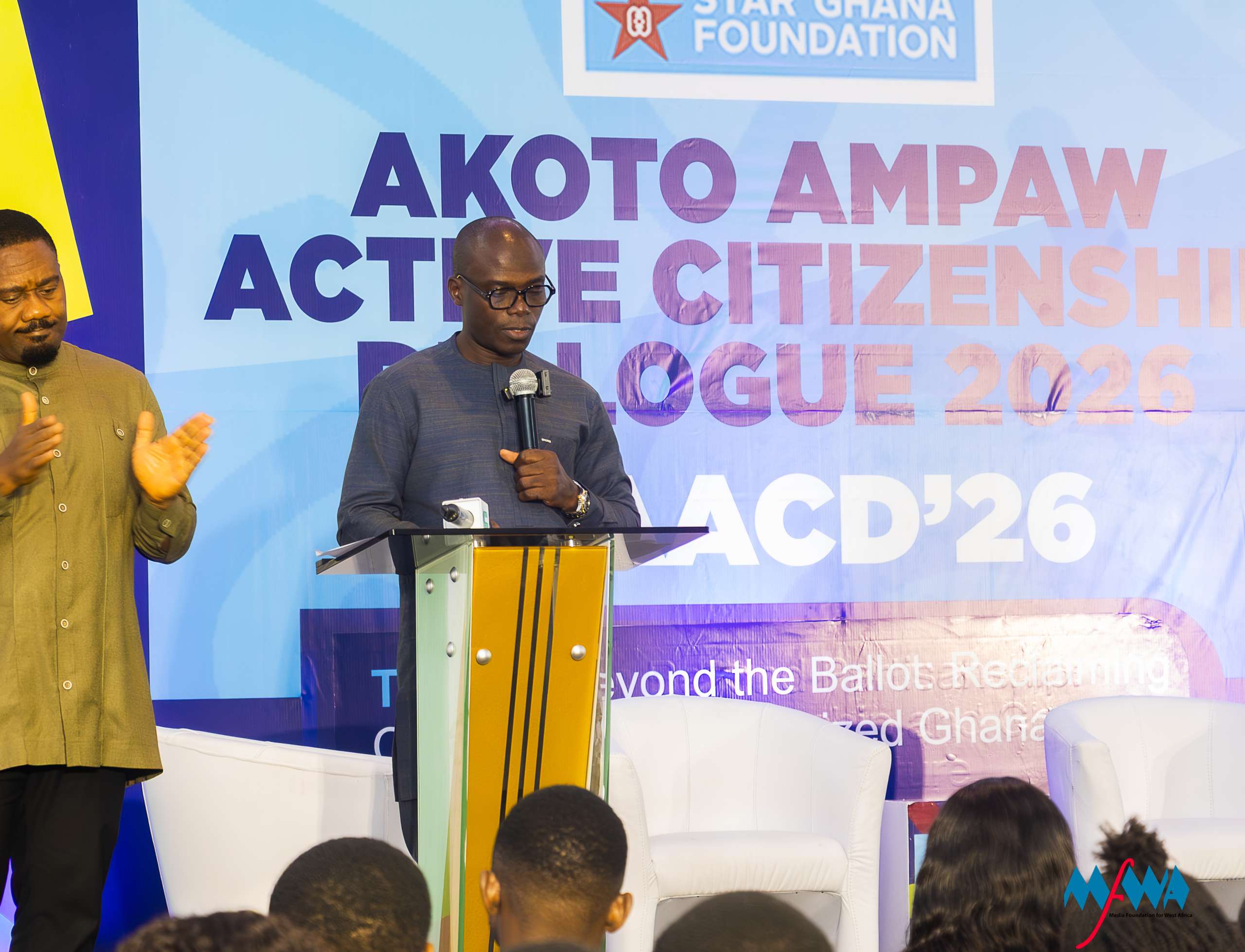
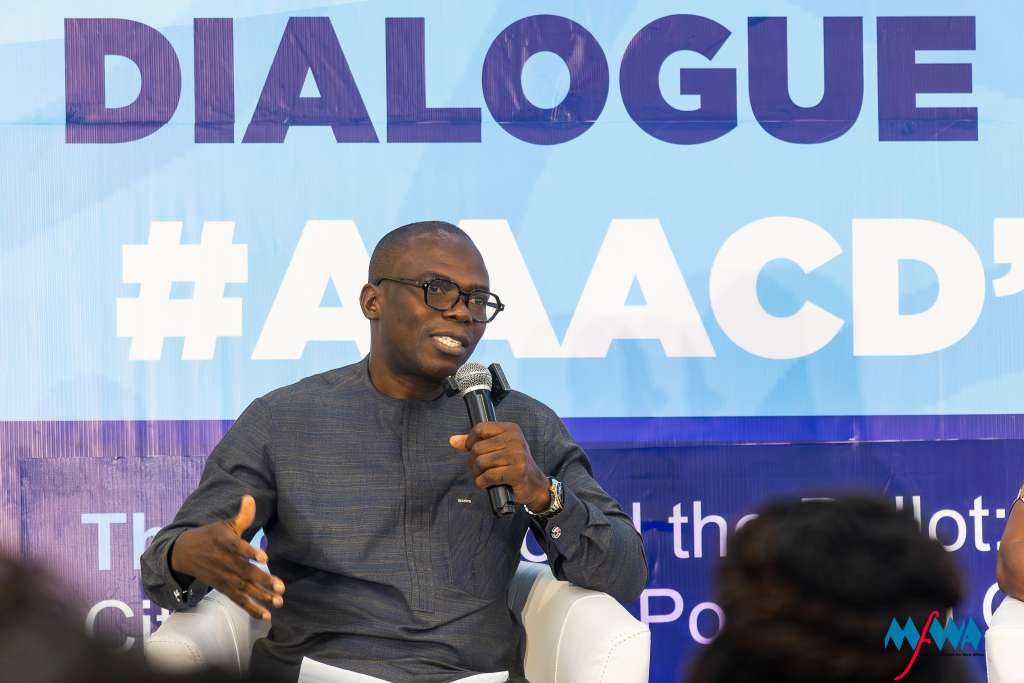
The Executive Director of the Media Foundation for West Africa (MFWA), Mr. Sulemana Braimah, has urged Ghanaians to embrace a more participatory form of citizenship that extends beyond periodic voting, stressing that sustained civic engagement is critical to democratic growth and national development.
Mr. Braimah made the call while delivering the keynote address at the 2026 edition of the Akoto Ampaw Active Citizenship Dialogue held in Accra.
Organised by the STAR-Ghana Foundation, the Dialogue is an annual platform that brings together citizens, civil society actors, youth and policy influencers to deliberate on issues of democracy, civic responsibility and national development. The event honours the legacy of Akoto Ampaw, a distinguished legal practitioner and pro-democracy advocate.
Citizenship beyond the ballot
Advocating what he described as active citizenship, Mr. Braimah emphasised that voting, while essential, is insufficient on its own to sustain a functioning democracy.
“Taking part in voting is important,” he observed, but “democracy cannot survive if citizenship is practiced only every four years.”
He reiterated that citizens must continuously engage in governance processes in order to contribute meaningfully to national development.
A democracy under strain
Mr. Braimah noted that although Ghana has earned recognition for its democratic stability since the 1992 Constitution, the country is confronted with the challenge of growing political polarisation and a lack of deliberative civic engagement between elections. He observed that civic participation often peaks during election cycles but declines significantly thereafter, weakening accountability and undermining inclusive governance.
“Democracy cannot survive if citizenship is practised only every four years,” he cautioned.
Illustrating active citizenship
To underscore his message, Mr. Braimah shared a scenario highlighting the contrast between passive and active citizenship.
He invited the audience to imagine a familiar Ghanaian neighbourhood during the rainy season where the gutters are clogged with plastic waste. Each downpour floods the streets, disrupting lives and livelihoods. Residents gather, not to act, but to argue. One blames the government. Another blames the opposition. A third blames past leaders. Their words grow louder, sharper, each shaped more by political loyalty than by a desire to solve the problem.
But the rain does not listen.
Then, in a quiet turn of events, ten young people in the community decide to act. Armed with shovels and a shared sense of responsibility, they clear the gutters in a single morning. When the rains return that evening, the water flows freely, and the streets remain passable.
In that moment, the question becomes unavoidable: “Who truly solved the problem?”
The answer, Mr. Braimah indicated, lies in the actions of citizens themselves, rather than solely in political blame sharing.
Lessons from Ghana’s history
Mr Braimah reminded participants that Ghana’s most significant milestones were achieved through sustained citizen action.
He cited the struggle for independence in 1957 and the transition to constitutional rule in 1992 as examples of collective citizen action. He noted that these achievements were not altruistically granted; they were earned through sustained mobilisation by ordinary citizens, including students, workers, journalists and civil society actors.
Rising polarisation
The MFWA Executive Director expressed concern about the growing polarisation, of public discourse, warning that partisan loyalties increasingly overshadow national interest..
He observed that collective national challenges are often reduced to political contestation, making consensus-building more difficult and eroding trust in public institutions.
The role of the youth
Addressing young people, who constitute a significant proportion of the population, Mr. Braimah acknowledged their active participation in public discourse, particularly through digital platforms such as X and Facebook.
However, he cautioned that such engagement must be constructive and contribute to national development rather than deepen divisions.
He stressed that the critical issue is not whether young people have influence, but how they choose to apply it.
A call to action
Reinforcing the need for sustained civic responsibility, Mr. Braimah urged citizens to reclaim their role as active participants in governance and development.
“Citizenship is not a status; it is a responsibility. It means showing up, not just every four years, but every day,” Mr. Braimah said.
He urged citizens to actively participate in community initiatives, engage in governance processes, demand accountability, and prioritise national interest over partisan considerations.
He stressed that Ghana’s democratic future will be determined not solely by political institutions such as the Presidency or Parliament, but also by the everyday actions of citizens in their communities.
Defining a generation
Mr. Braimah concluded by challenging citizens, particularly the youth, to reflect on the legacy they wish to leave behind.
He said that the future of Ghana will belong not to those who speak the loudest, but to those who choose to act.