


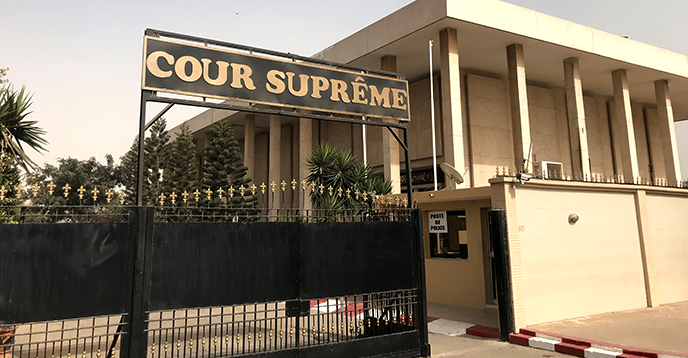
On Thursday, December 11, 2025, Senegal’s Supreme Court delivered a landmark ruling on the country’s media regulatory framework. Acting on a petition filed by the Conseil des diffuseurs et éditeurs de presse du Sénégal (CDEPS), an umbrella body representing private media organisations, the Court annulled two ministerial orders issued by the Ministry of Communication.
The annulled orders, No. 017412 of July 29, 2024, and No. 024462 of October 1, 2024, had established a digital platform for the registration and identification of media enterprises. Under these measures, access to benefits associated with recognised media enterprise status was made conditional on prior registration on the platform, effectively introducing an additional layer of administrative approval beyond existing legal requirements.
Following the adoption of the orders, the government set up the Commission for the Examination and Validation of Media Enterprises on October 4, 2024. The commission was tasked with assessing compliance with the Press Code. Of the 639 media outlets identified and evaluated, 258 were declared compliant, while 381 were deemed non-compliant. On April 22, 2025, the Minister of Communication, Telecommunications and Digital Media, Alioune Sall, signed a decree ordering the suspension of the 381 outlets.
In its ruling, the Supreme Court relied on Articles 68, 134, and 135 of Senegal’s Press Code, holding that the recognition of media enterprise status is governed by criteria clearly defined in law. The Court found that this status cannot be made subject to additional procedures introduced through ministerial orders. It further held that the Minister of Communication had exceeded his authority by imposing a registration obligation not provided for in the existing legislative framework, which is already regulated by Decree No. 2021-171 of January 27, 2022.
As a result, the Court declared both the digital registration platform and the commission responsible for examining and validating media enterprises unlawful. It also invalidated all sanctions imposed on media outlets that had not registered under the annulled system, effectively removing the legal basis for the suspension of the 381 affected outlets.
Reacting to the ruling, officials from the Ministry of Communication maintained that the law grants the ministry powers to register media enterprises. The ministry indicated that, following the Court’s decision, it would dissolve the commission and continue to exercise its regulatory responsibilities within what it considers the limits of the Press Code.
The Media Foundation for West Africa welcomes the Supreme Court’s decision as a strong affirmation of the rule of law and constitutional guarantees of press freedom in Senegal. The ruling reinforces the principle that media regulation must strictly adhere to existing legal frameworks and that administrative measures should not be used to impose additional constraints on the practice of journalism.
The Foundation also notes that the annulled Ministry orders formed part of a broader series of regulatory and administrative measures that have significantly disrupted Senegal’s media landscape since 2024, including the freezing of media bank accounts and the suspension of state advertising contracts. MFWA urges the Senegalese authorities to ensure that future regulatory efforts prioritise dialogue and the protection of media freedoms.


