


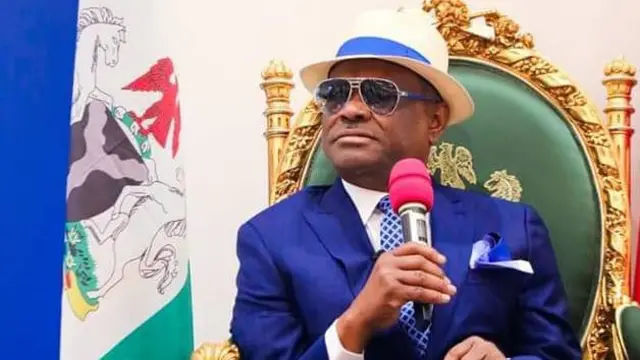
Nigeria’s Minister of the Federal Capital Territory (FCT), Nyesom Wike, on April 3, 2026, stated during a media chat (an informal engagement between a public official and journalists) in Abuja that he “would have shot” Seun Okinbaloye, a journalist with Channels Television, over comments the journalist made about the risk of Nigeria becoming a one-party state.
The remark followed an April 2, 2026, broadcast of “Politics Today”, where Okinbaloye discussed Nigeria’s evolving political dynamics, focusing on the leadership crisis within the African Democratic Congress (ADC). The dispute involves rival factions led by David Mark, a senior politician and former military officer, and Nafiu Bala Gombe, also a senior political figure. On April 1, 2026, the Independent National Electoral Commission (INEC) announced it would no longer recognise either faction, citing a Court of Appeal ruling delivered on March 12, 2026. The Mark-led faction rejected the decision, alleging external influence.
During the programme, Okinbaloye warned that instability within opposition parties could weaken democratic competition ahead of the 2027 elections. He noted that if a major opposition platform is unable to function effectively, Nigeria risks drifting towards a one-party-dominated system.
Clips of the programme circulated widely on social media, drawing mixed reactions. While some viewers defended the journalist’s line of questioning as part of his professional duty, others criticised his tone as confrontational.
Reacting a day later, Wike criticised Okinbaloye for expressing what he described as a personal opinion on national television. “I was surprised yesterday, thoroughly surprised. When I was watching Politics Today, Seun. If there was any way to break the screen, I would have shot him,” the FCT minister said. “How can you, as an interviewer, say we cannot have only one party? You are an interviewer; you are now telling them your own views. There is nothing wrong with asking your interviewee questions. But you are now the one on national television making that kind of statement, which means you have already taken a position.”
On April 5, 2026, Okinbaloye responded, stating that he was not intimidated and would continue to carry out his duties without fear. He reaffirmed his commitment to holding public officials accountable and maintaining professional standards.
Wike later clarified on April 7, 2026, that his comment was figurative and not intended as a literal threat. He maintained that journalists should remain neutral in their questioning.
The incident generated backlash from civil society and media organisations. A coalition of 14 groups, including the MFWA’s national partner International Press Centre (IPC), issued a joint statement condemning the use of aggressive language by public officials.
The Nigeria Union of Journalists (NUJ) described the remark as irresponsible and called for a public apology. “This incendiary comment from a high-ranking government official is not only deeply disturbing but also creates a climate of fear for journalists striving to uphold their professional duties. It sends a dangerous message that critical reporting will be met with hostility and threats of violence, which is entirely antithetical to the spirit of a free and open society. The NUJ unequivocally demands an immediate and unreserved apology from Barrister Nyesom Wike for his reprehensible remarks.”
The Independent Broadcasters Association of Nigeria also warned it could reconsider engagement with the minister if no apology is issued.
The Media Foundation for West Africa (MFWA) stresses that while public officials are free to opine on a journalist’s comments, the use of language that can be construed as violent or threatening language, no matter the public official’s intent, is unacceptable. Such rhetoric risks fostering a climate of intimidation and undermines press freedom especially in a country that has seen its share of violent attacks on journalists and media organisations in the past years. The MFWA aligns itself with the demands of the NUJ and urges authorities to ensure that journalists can operate without fear of harassment in the country.


