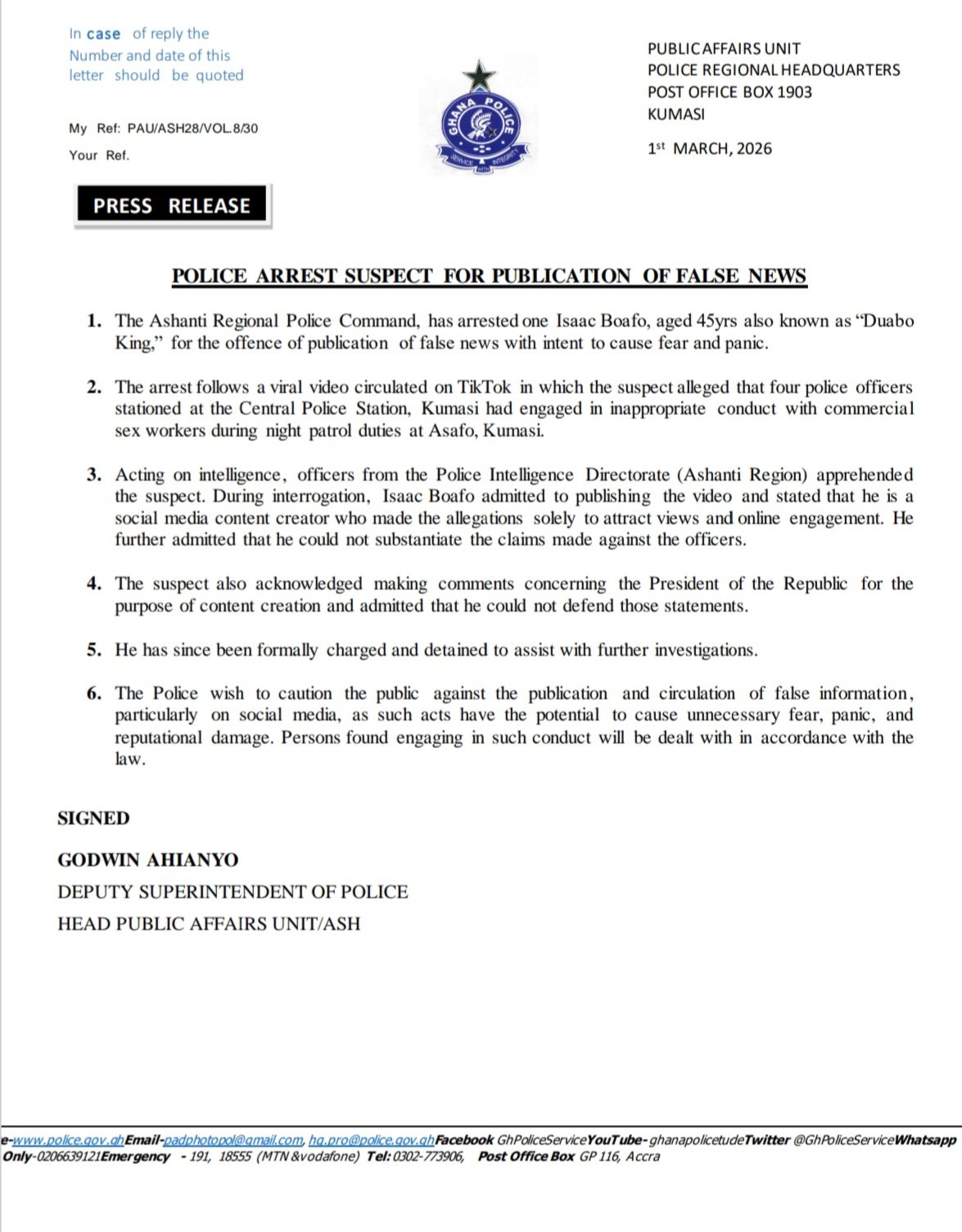


Isaac Boafo, a 45-year-old social media content creator popularly known online as “Duabo King”, was arrested on March 1, 2026, by officers from the Police Intelligence Directorate at the Ashanti Regional Police Command. According to a statement issued by the Ghana Police Service Regional Headquarters in Kumasi, the arrest followed a viral TikTok video in which Boafo allegedly made false claims about police officers stationed at the Central Command Police Station in Kumasi.
In the video, Boafo alleged that four officers from the station had engaged in inappropriate sexual conduct with commercial sex workers while on night patrol duties in the Asafo area of Kumasi.
The Ghana Police Service stated that during interrogation Boafo admitted the allegations were unsubstantiated. According to the police statement, he acknowledged that he had fabricated the claims in order to attract views and engagement on social media. He also admitted making comments about the President of the Republic for the purpose of content creation and stated that he could not defend those remarks.
Boafo has since been charged with the publication and circulation of false information. He remains in police custody while assisting with ongoing investigations.
In its statement, the police issued a public warning against the spread of false information. “Persons found engaging in such conduct will be dealt with in accordance with the law,” the statement read. It was signed by Deputy Superintendent of Police Godwin Ahianyo, Head of the Public Affairs Unit of the Ashanti Regional Police Command.
Boafo’s case reflects the continued reliance on criminal provisions to address alleged misinformation in Ghana. In recent years, individuals including bloggers and activists have been arrested or charged under Section 208 of the Criminal and Other Offences Act, 1960 (Act 29), and in some cases Section 76 of the Electronic Communications Act, 2008 (Act 775). The Media Foundation for West Africa has raised concerns that these provisions are increasingly being used to pursue speech-related offences following the repeal of Ghana’s criminal libel law.
In this instance, the police state that Boafo admitted to fabricating allegations against officers of the Central Police Station in Kumasi in order to gain online engagement. While that admission distinguishes the case from others in which the accused contest the allegations, it nonetheless illustrates the continuing use of criminal investigation and detention in response to disputed or misleading speech online.
The Media Foundation for West Africa (MFWA) reiterates that while deliberate misinformation is harmful and should be addressed, responses should remain proportionate and consistent with Ghana’s constitutional protections for freedom of expression. The organisation therefore encourages authorities to ensure that enforcement measures do not unduly restrict legitimate expression or recreate the punitive effects associated with the former criminal libel regime.