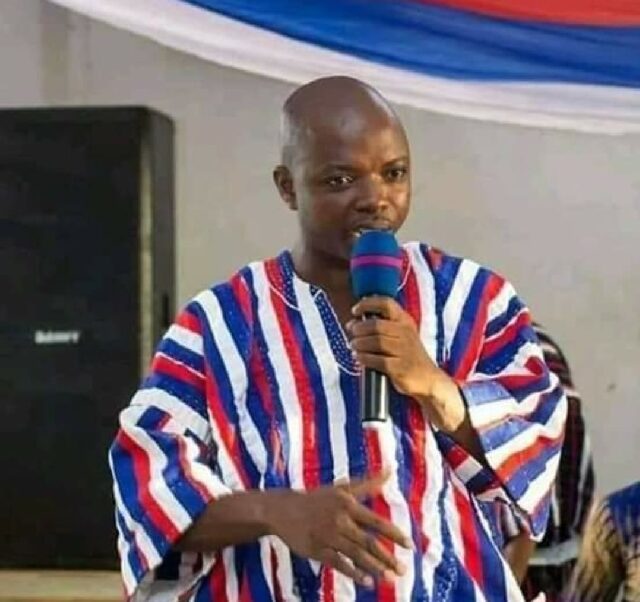
Kwame Baffoe, the Bono Regional Chairman of the opposition New Patriotic Party (NPP) known as Abronye DC, has been arrested by the Ghana Police Service on charges of offensive conduct likely to breach public peace and publication of false news.
Baffoe was taken into custody on September 8, 2025, after attending an invitation by the Criminal Investigations Department (CID) for questioning. During the interrogation, which lasted over two hours, police reportedly played a video in which Baffoe criticised the Inspector General of Police, Christian Tetteh Yohonu. Following this, he was formally charged and remanded into police custody.
The arrest comes shortly after Baffoe reportedly submitted applications for political asylum in eight countries, Côte d’Ivoire, the United States, France, Italy, Canada, Spain, the United Kingdom, and Germany, alleging political persecution, threats to his life, and abuse of state security powers by the current government.
Prior to his arrest, armed police officers reportedly raided the residence of former NPP Greater Accra Youth Organiser Moses Abor on September 7, allegedly searching for Baffoe. His exact location remained unclear for several hours, with his lawyers noting that after initial processing at CID headquarters, he was reportedly moved to the National Intelligence Bureau, though officials there denied having received him.
The charges against Baffoe, though not yet detailed publicly, relate to statements considered likely to disturb public peace and to contain falsehoods. Legal experts note that Ghanaian law, including Section 208 of the Criminal Offences Act (Act 29) and Section 76 of the Electronic Communications Act (Act 775), has been used in similar cases to criminalise statements deemed offensive or misleading, raising long-standing concerns about proportionality and freedom of expression.
The Media Foundation for West Africa (MFWA) urges the Ghana Police Service to ensure Baffoe’s due process rights are fully respected, including prompt access to legal counsel and transparent communication about his detention. MFWA also calls on the government to review the use of criminal provisions that penalise political commentary, emphasising civil remedies as a more appropriate mechanism for addressing disputes over public statements.