
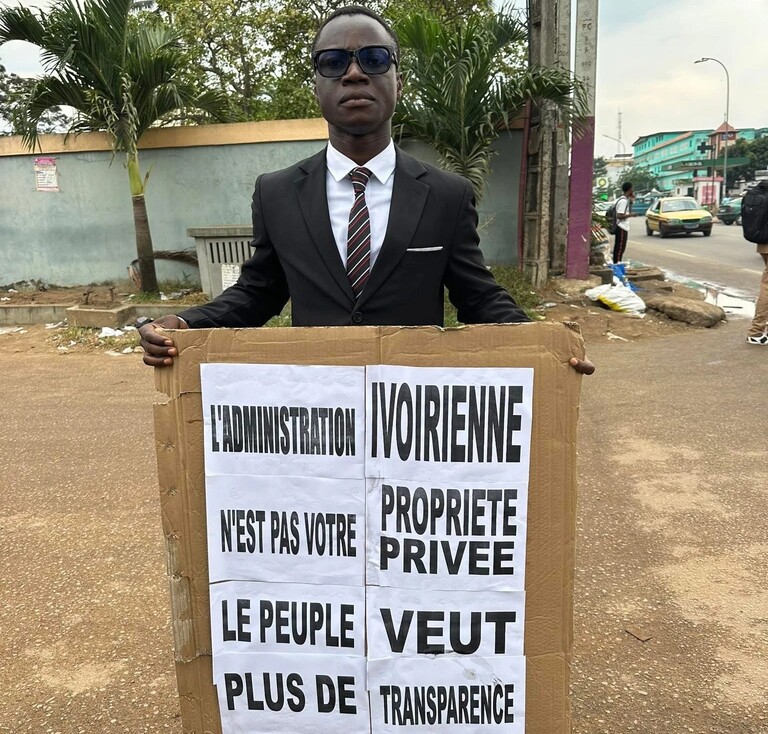
Jean-François Kouassi, also known as JFK, a youth leader in Côte d’Ivoire, has been convicted and sentenced to a suspended prison term following his public criticisms of alleged irregularities in civil service recruitment.
The case stems from comments made by Kouassi on his Facebook page on January 8, 2026. In the post, he alleged that access to public service examinations was influenced by corruption, nepotism, and political affiliation. He claimed that many young people felt compelled to join the ruling RHDP party to improve their chances of recruitment, describing the situation as a “state scandal”.
He also called for scrutiny of the recruitment process overseen by former Minister of Public Service Anne Désirée Ouloto, now a member of parliament on the ticket of the ruling party. Later the same day, Kouassi announced that he had been arrested.
According to a report, he was arrested in front of the Ministry of Public Service in Plateau, Abidjan, where he was protesting alleged irregularities, including claims surrounding the recruitment of 400 customs officers without open competitive examinations.
He was first held in police custody before being presented to judicial authorities on January 12, 2026 and placed in pre-trial detention. Prosecutors charged him with disturbing public order, defamation, spreading false information online, and false denunciation. During the trial, the prosecution argued that his actions risked undermining public order and harming the reputation of individuals involved in the recruitment process.
On Monday, January 26, 2026, the Plateau Court in Abidjan sentenced Kouassi, president of the Mouvement des jeunes de Côte d’Ivoire (MJCI), to 15 days’ imprisonment, eight months’ suspended imprisonment, and a fine of 500,000 CFA francs (about USD 830). He was released on January 27, 2026, after spending 19 days in detention, a period that exceeded the 15-day prison sentence imposed, calculated from his arrest on January 8, 2026.
Kouassi’s lawyers contended that he was speaking as a citizen raising concerns about barriers faced by young people in accessing public sector employment. They stated that his intention was to alert authorities to perceived injustices rather than to incite disorder, and have announced their intention to appeal the court’s decision.
The Media Foundation for West Africa (MFWA) urges the Ivorian authorities to uphold the right of citizens to express views on governance and public administration. Where authorities consider such claims to be inaccurate or misleading, appropriate non-custodial avenues exist to clarify the facts and set the record straight. Resorting to arrest and criminal prosecution for peaceful expression risks narrowing civic space. The MFWA further calls for the conviction of Jean-François Kouassi to be reviewed and overturned.