
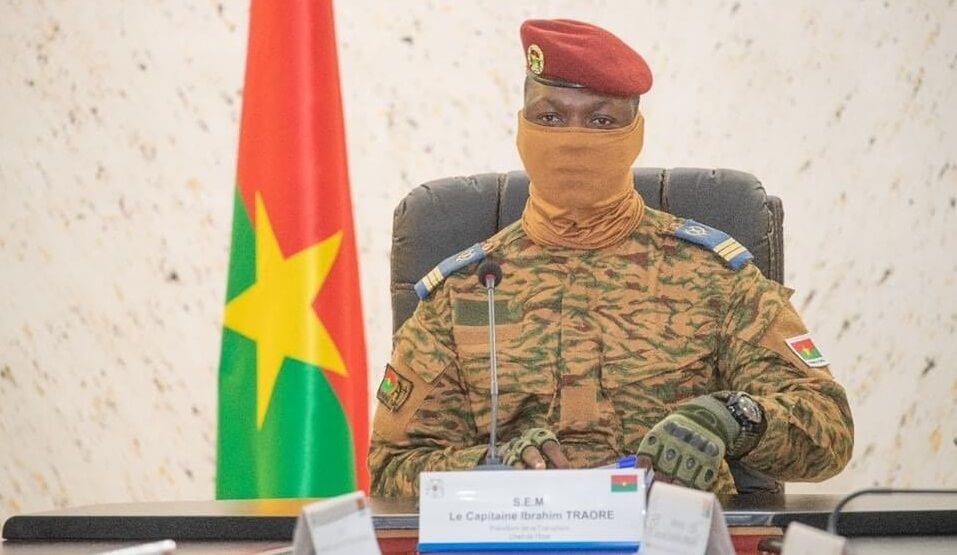
Burkina Faso’s transitional authorities have taken a decisive step that could reshape the country’s political landscape. On February 9, 2026, members of Burkina Faso’s Transitional Legislative Assembly (ALT) adopted a bill dissolving all political parties and political groupings in the country. The decision follows a decree issued by the Council of Ministers on January 29, 2026 and represents one of the most consequential political measures introduced since the military takeover of September 30, 2022.
According to the Minister of State for Territorial Administration and Mobility, Émile Zerbo, the measure aims to “better regulate political life and pluralism, preserve national unity, and defend the state.” The government argues that political parties and groups have become increasingly disconnected from the aspirations of the Burkinabè population and from the country’s strategic priorities, particularly in the context of the ongoing security crisis.
Authorities further contend that the activities of political parties have contributed to divisions within society, weakened social cohesion, and aggravated regional imbalances in development. The decree therefore provides not only for the dissolution of political parties and political groups but also for the transfer of their assets to the state and the repeal of the laws governing political parties, their financing, and the status of the political opposition.
The measure formalises restrictions that had already been in place since the early period of military rule. Following the September 2022 coup, the transitional authorities suspended the activities of political parties and groups, presenting the decision as a temporary measure justified by the country’s security and governance context. While that suspension effectively curtailed organised political activity, it stopped short of formally dismantling the legal framework governing political parties.
A legal framework governing political life
Prior to the dissolution, Burkina Faso had an established legal framework regulating political life. Article 13 of the Constitution of June 2, 1991 guarantees the freedom to form political parties and recognises their role in organising political participation and facilitating democratic competition through elections.
This constitutional guarantee aligns with Burkina Faso’s obligations under international and regional human rights instruments, including the African Charter on Human and Peoples’ Rights and the International Covenant on Civil and Political Rights. Both frameworks recognise freedom of association and political participation as fundamental rights, allowing restrictions only where they are lawful, necessary, and proportionate.
In addition to constitutional protections, the country had a set of laws governing political parties and political groupings, including regulations concerning their creation, internal organisation, financing, and dissolution. Separate legislation also defined the institutional role and rights of the political opposition. These legal instruments were designed to ensure transparency, regulate political competition, and provide mechanisms to sanction parties that violated established rules.
In principle, therefore, the existing legal framework already offered tools to regulate or dissolve political organisations that failed to comply with the law. The wholesale dissolution of all political parties marks a significant departure from this regulatory approach.
Implications for political participation and governance
The abolition of political parties raises important questions about the future of political governance in Burkina Faso, particularly with regard to citizen participation and the organisation of future electoral processes.
Political parties serve as central vehicles for political representation, enabling citizens to organise collectively, articulate policy alternatives, and compete for public office. Their disappearance risks concentrating political authority in the hands of the transitional authorities while limiting institutional channels through which citizens can participate in public affairs.
Without organised political formations, the ability of different social groups to mobilise and express their political preferences may be significantly reduced. This could weaken pluralistic debate and further narrow the space for structured political competition, both of which are essential components of democratic governance.
The dissolution of political parties also raises uncertainty about the institutional architecture that will underpin any future transition to constitutional rule. Political parties typically play a key role in negotiating transitions, structuring electoral competition, and translating public demands into policy programmes. Their absence could complicate efforts to restore representative institutions.
Regional trends in the Sahel
Burkina Faso’s decision also reflects a broader trend in the Alliance of Sahel States (AES) where the military governments have restructured political systems in ways that reduce the role of traditional political actors.
In Mali and Niger, transitional authorities have likewise first suspended and then dissolved political parties and activities, citing national security imperatives and the perceived failure of political elites to address governance and security crises. In these contexts, political parties are often portrayed as ineffective, corrupt, or disconnected from the population, narratives that are used to justify the consolidation of executive authority under military-led transitions.
While these arguments resonate with segments of the public frustrated with past political leadership, the weakening or dismantling of political parties raises concerns about the long-term prospects for democratic governance in the region. Political parties remain essential institutions for structuring political competition, aggregating citizen interests, and ensuring accountability in representative systems.
The transition paradox
The dissolution of political parties also highlights a broader paradox within several military-led transitions in West Africa. Transitional authorities frequently frame their actions as necessary steps to rebuild institutions and prepare the ground for more credible democratic systems. Yet, the suspension or dismantling of political organisations risks undermining the very institutional foundations required for a future democratic transition.
In the absence of functioning political parties, it becomes more difficult to organise competitive elections, develop coherent political programmes, and ensure that a broad spectrum of societal interests is represented in governance processes. As a result, measures introduced in the name of stabilisation may ultimately complicate or delay the restoration of constitutional order.
A shrinking civic space
The dissolution of political parties occurs within a broader context of shrinking civic space in Burkina Faso since the 2022 coup. Independent institutions, including the media, civil society, and more recently the judiciary, have come under growing pressure. Arrests, detentions, abductions, enforced disappearances and forced conscriptions have been reported in several cases.
This pressure from the transitional authorities has ratcheted up in the last six months following a wave of arrests that sent shockwaves through the country. In October 2025, six journalists were arrested and detained. Michel Nana, associate editor of Éditions Le Pays, was taken on October 13, followed by Ousséni Ilboudo, managing editor of L’Observateur Paalga later that day. There were two more arrests on October 14: Zowenmanogo Dieudonné Zoungrana, director of Aujourd’hui au Faso and Lamine Traoré, founder of the online outlet Burkina Yawana. On October 16, Alain Zongo, the editor-in-chief of l’Observateur Paalga was detained by agents of the National Intelligence Agency. On October 24, Jean-Marie, editor-in-chief of Sidwaya, the state-owned daily was also arrested.
Around the same time, six judicial officers were also arrested, including four judges of the Ouagadougou Court of Appeal: Urbain Méda, Seydou Sanou, Benoît Zoungrana, and Alban Somé, alongside Deputy Prosecutor General Moussa Dianda, and former Attorney General Jean-Jacques Wendpanga Ouedraogo. A lawyer, Arnaud Sempebré, also went missing within the same period and was presumed abducted.
This wave of arrests targeting senior media executives and judicial officials completely exposed the vulnerability of institutions traditionally expected to provide oversight and accountability. The targeting of both sectors sent a deliberate and chilling signal about the shrinking space for independent scrutiny of state authority in Burkina Faso.
Conclusion
The Media Foundation for West Africa (MFWA) is deeply concerned over the dissolution of political parties and the broader implications of this latest development in the steady erosion of democratic participation in Burkina Faso. The MFWA stresses that preserving spaces where citizens can freely express their views, organise politically, and participate in public debate remains essential for democratic governance.
The organisation calls on the transitional authorities to safeguard the rights to freedom of expression, assembly, and political participation, and to ensure that any security-related measures remain consistent with national and international legal obligations. The MFWA also urges the authorities to put an end to unjustified detentions and to release all individuals held without due process.
Finally, the MFWA calls on the African Union, international partners, media and human rights organisations, and civil society actors to act urgently to protect journalists and other independent voices, safeguard civic freedoms, and restore an enabling environment for democratic participation of citizens in Burkina Faso.