
After two years, Ghanaian journalists Bridget Otoo, Vanessa Edotom Boateng, and activist George Gyening Anyang, have won a court case against the Inspector General of Police and the Attorney General for the assault meted out to them during a protest in September 2023.
The Human Rights Division Court at the Accra High Court of Justice, on May 14, 2026, condemned the police assault on the journalists and activist during the #OccupyJulorbiHouse protest in September 2023, delivering judgment in favour of the victims.
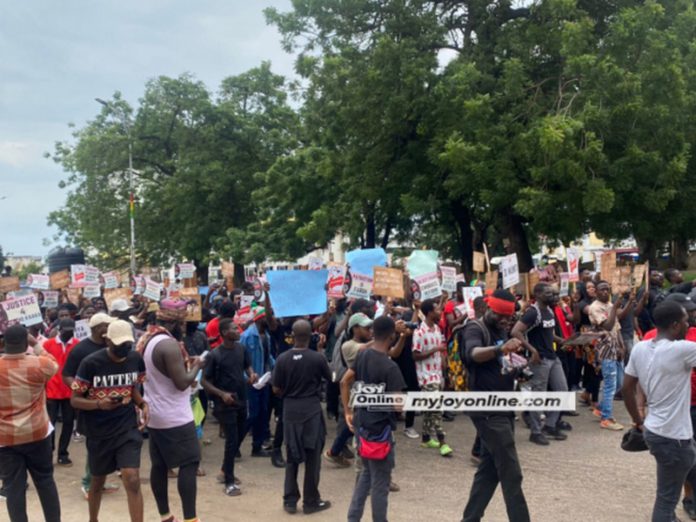
On September 21, 2023, civil society group Democracy Hub organised a three-day protest to register displeasure with the government over concerns of economic hardship, illegal mining, and corruption. The protest was termed #OccupyJulorbiHouse, meaning “Occupy the Jubilee House,” the seat of government.
During the protest, the police attacked and tore Metro TV journalist Bridget Otoo’s blouse during an assault, while Vanessa Edotom Boateng was unlawfully detained and stripped of her phone to prevent her from filming the brutality. George Gyening Anyang was slapped, punched in the face, and whipped with a metal belt and baton as he livestreamed events at the regional police station.
Bridget’s assault went viral on social media, with many criticising the Ghana Police Service. In March 2024, Bridget Otoo, Vanessa Edotom Boateng, and George Gyening Anyang sued the Inspector General of Police and the Attorney General following the assault they endured during the protest.
On May 14, 2026, the court, presided over by His Lordship Justice Nana Brew, ruled that the assault on Otoo who is now a presidential staffer, amounted to police misconduct and a violation of human rights. The lawyer for the three protestors Samson Lardy Anyenini confirmed the judgment to the Media Foundation for West Africa (MFWA).
Court documents confirmed that the three individuals were present at the #OccupyJulorbiHouse demonstration on September 21, 2023, suffered a violation of their rights, and that officers of the Ghana Police Service violated the fundamental rights of the journalists and activist they were duty-bound to protect. The judge also described the police conduct as “unconstitutional,” citing physical assaults and unlawful interference with the victims’ rights.
The court awarded the three protestors compensatory damages of GH₵100,000 (US$8,580), general damages of GH₵50,000 (US$4,290), and GH₵30,000 (US$2,573) in legal costs, significantly less than the GH₵1,000,000 (US$85,770) in compensatory damages they had sought. The court also directed the Police to publish an unqualified formal apology in the state newspaper, the Daily Graphic.
Counsel for the claimants, Samson Lardy Anyenini, told the MFWA that he was disappointed with the court’s approach to compensation for victims. The victims received only 18% of the damages they had prayed the court for. “The quantum of damages continues to be my problem in these human rights actions for journalists,” Samson said.
While counsel sought higher costs to reflect two years of litigation, the court declined, noting that such large monetary awards could “cripple” the police service’s ability to function effectively.
Justice Brew expressed hope that under the new Inspector General of Police, the Police Service would prioritise the protection of rights, not only of journalists, but also of the public generally.
Speaking in an interview with the Media Foundation for West Africa, Vanessa Edotom Boateng told the MFWA although the process of seeking justice was incredibly difficult and emotionally draining, the court ruling affirmed that what happened to them was unconstitutional.
She described the delays, frequent adjournments, constant court appearances, repeated filings in the two-year period as both challenging and financially draining.
“The financial constraint is really significant. These cases are very expensive to sustain. Some lawyers are sometimes discouraged or just abandon such cases because there is little immediate financial reward. Legal fees are simply too high for most journalists, people like myself, and ordinary citizens”, Vanessa told the MFWA.
Despite this, the journalist is encouraging her fellow journalists to pursue justice when their rights are violated, expressing hope they will eventually get it even though the process can be daunting.
“Pursue justice if you can. You should, because you deserve it as a journalist. Your rights shouldn’t be taken for granted. The fact that we came out has given some reassurance that there is still justice. We still believe in a justice system”, the journalist stated.
Many journalists’ rights are violated in the course of their work. In many instances, justice is not served and investigations into the violations drag on for years without updates but journalists rarely tell stories about themselves.
“As journalists, we often tell other people’s stories, but this experience reminded me that we also deserve protection under the law when our rights are violated”, Vanessa told the MFWA.
In 2023, the same Human Rights Division Court 2 in Accra ruled that Ghana’s National Security Coordinator, the Inspector General of Police, and the Attorney General render an apology to the Editor of online news portal ModernGhanaonline.com, Emmanuel Ajarfor Abugri. The Editor was abducted and tortured by National Security Operatives in 2019 over two articles that his platform had published. The court ruled that his rights were abused and ordered the institutions to pay compensation and costs to the journalist.
Beyond Ajarfor’s case, in many cases of freedom of expression violations victims rarely receive justice, court proceedings drag on for years without resolution, creating a culture of impunity exists. For instance, the court case of JoyNews journalist Latif Iddrisu who was assaulted by police officers on March 27, 2018 remains unresolved after eight years. The case has been delayed on several occasions due to the absence of state attorneys or police witnesses, despite prior agreement on hearing dates.
Each adjournment has extended the litigation timeline and deferred resolution. However, on February 17, 2026, the state informed the court that the Inspector General of Police and the Attorney General had initiated steps to compensate the journalist and settle the matter, a development the MFWA has welcomed.
In a separate case arising from an assault Latif faced in May 2025, criminal proceedings commenced in February 2026. While this is a positive development, the proceedings must be expedited to serve justice to the journalist. This case must not be allowed to stay in court for years.
The Media Foundation for West Africa welcomes the court’s decision as a breakthrough in the fight against impunity. This is particularly significant given that the perpetrators are security personnel from institutions expected to play a frontline role in protecting journalists from attack. The MFWA urges the judiciary to award befitting compensation to victims of assault and police brutality, and calls on security personnel to uphold professionalism.