
The Mauritanian government has blocked a rally organised by the Alliance for Justice and Democracy (AJD) one of the main opposition parties. The rally was scheduled to take place on February 11, 2026, to announce the launch of the Coalition for Peaceful Change 2029 (CAD), a new alliance bringing together several opposition parties. According to its organisers, the coalition aims to “end corruption and circumvention of the law” and to promote a democratic alternative.
Although authorisation had reportedly been granted in advance, it was withdrawn just hours before the event by the Ministry of Decentralisation and Local Development.
According to Biram Dah Abeid, a member of parliament and president of the Initiative for the Resurgence of the Abolitionist Movement (IRA), the decision was linked to social media mobilisation around the rally. Local media reports indicate that authorities were concerned about calls by bloggers encouraging mass participation.
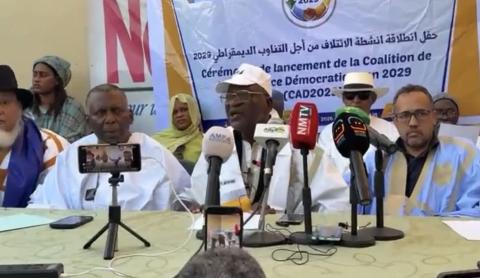
Following the withdrawal of authorisation, organisers replaced the rally with a press conference held at the coalition’s headquarters on the same day. Leaders of the coalition have condemned the decision, describing it as an act of political obstruction and harassment targeting opposition groups.
The incident reflects broader concerns about the state of civic space in Mauritania. In 2025, there were increasing reports of restrictions on freedom of expression, including arrests and prosecutions linked to social media commentary and critical reporting. Media outlets and individuals perceived as critical of the authorities were, in several cases, subjected to judicial or administrative measures.
Opposition figures and civil society actors have also faced legal action in connection with their advocacy on governance issues, contributing to what observers describe as a more restricted environment for political participation and public debate.
The Media Foundation for West Africa (MFWA) calls on the Mauritanian authorities to ensure that restrictions on public gatherings are applied in a manner consistent with national and international legal standards. The organisation further urges authorities to take concrete steps to protect freedom of expression, assembly, and political participation, and to foster an open and pluralistic civic space.