


In recent years, democracy in West Africa has faced serious setbacks. Countries in the Sahel region, Niger, Mali, and Burkina Faso, and others like Guinea and Guinea-Bissau have experienced military takeovers accompanied by violations of freedom of expression and press freedom. These violations have been severe enough to force journalists and civil society actors to flee their home countries for their own safety. Military rule, however, is not the only driver of exile. Across the region, journalists have also been forced to leave their countries after publishing investigations that powerful political or economic actors sought to suppress.
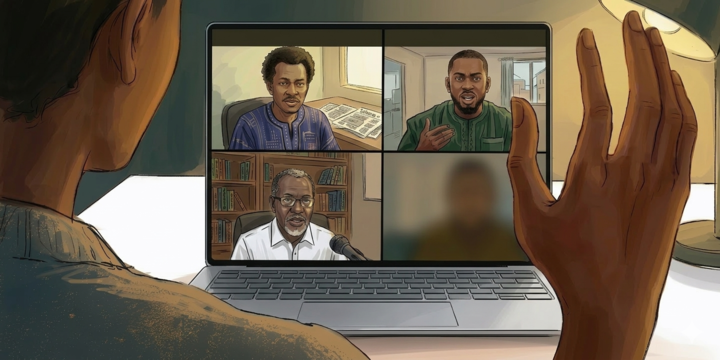
Against this backdrop, the Media Foundation for West Africa (MFWA) organised a webinar titled “Voices from Exile” on February 27, 2026, under its project Mobilising Stakeholders and Action for Enhancing Freedom of Expression and Democratic Values in West Africa funded by the National Endowment for Democracy (NED). The online discussion brought together exiled journalists, media practitioners, civil society actors and legal experts to share experiences and examine responses to the growing safety crisis facing journalists in the region.
The discussion focused on the state of freedom of expression in West Africa and the lived realities of journalists forced into exile, particularly in the context of deteriorating security conditions in parts of the Sahel. Participants also explored the broader implications of these developments for press freedom, independent journalism and democratic governance.
In his opening remarks, Dr. Kojo Impraim, Director for the Media for Democracy and Good Governance Programme, MFWA, described the webinar as an important platform for proposing mechanisms to address current democratic challenges, strengthen freedom of expression, and advance a more citizen-centred vision of governance in which all voices are heard and respected. He expressed hope that the discussions would “distil these issues better for our country’s leaders” and serve as a catalyst for sustained advocacy.
Living in Exile
Jonathan (not his real name) is an investigative journalist who went into exile in 2023. But the pressures that took him into exile had been building long before that. Years of reporting on corruption had made enemies of powerful people who, in his words, “didn’t want us to publish.”
Before his departure, he faced multiple attempted arrests and sustained threats against both himself and his family, eventually leaving him with no option but to seek safety elsewhere.
Jonathan recounted a period in which he was left without valid identity documents; his passport expired and his national identity card was not recognised abroad. He was unable to do basic transactions and was not able to receive payment for freelance journalism work he did. “You end up improvising a life you never planned for,” he said.
For fellow exiled journalist Rahman (also a pseudonym), “Exile for journalists is not a choice,” he said. “It is a survival measure.”
Since the military assumed power in his country, Rahman described witnessing a deliberate and systematic dismantling of the country’s media landscape. Influential outlets were shut down gradually and investigative journalists were silenced or driven out. The justice system, Rahman recounted, rather than offering protection, was weaponised against the press and used to intimidate, prosecute, and imprison journalists.
For journalists who have had to leave their countries, exile has not brought them complete safety. Families of exiled journalists who remain in their home countries have become targets who are often subjected to harassment, detention, and in some cases, kidnapping. In one particularly alarming case, the father of an exiled Guinean journalist has been held in detention since September 2025.
“Exile does not mean the end of pressure,” Rahman said. Rahman now lives in a country without legal status, no institutional protection, no income and a proper structured life. He says he is only managing with what he called “extraordinary discipline” while carrying the weight of responsibilities for family members still at home.
Organisations equipped to assist journalists in his situation are, he noted, overwhelmed by the volume of requests and constrained by limited funding, leaving many to wait months for any response.
“It gives me goosebumps when I think about everything we have gone through,” Rahman said.
Legal Pathways for Journalists in Exile
Beyond the lived realities shared by the exiled journalists, the discussion featured insights on the legal defence options available to journalists and activists. Zakaria Tanko Musah Esq., a member of the MFWA’s regional network of activists and media defence lawyers (WANAMDEL) shared some tips with participants. He highlighted what he described as a critical but often overlooked issue: the limited awareness among exiled journalists of the legal protections available to them.
Tanko Musah called for stronger support systems to guide journalists through the process of seeking formal legal recognition when forced into exile. He reminded participants of the golden rule when going into exile: seeking the status of refugee guaranteed under the 1951 Geneva convention and encouraged journalists who go into exile to avoid using their countries’ identity documents since it can nullify their refugee status. Refugee status provides legal safeguards, formal recognition, and a foundation from which exiled journalists can begin to rebuild their lives and their work.
He also stressed the underutilised role of regional institutions like ECOWAS in addressing the crisis. The ECOWAS Court of Justice, he argued, remains a viable but largely untapped avenue through which exiled journalists can seek redress and protection. Press freedom organisations like the MFWA are also well positioned to help journalists navigate the process of being in exile.
For journalists from Sahelian countries that have withdrawn from ECOWAS (Mali, Burkina Faso, and Niger), the lawyer pointed to the African Court on Human and Peoples’ Rights, based in Arusha, Tanzania, as an alternative forum. He urged human rights advocates and media organisations to engage more actively with the Court, so that it looks beyond the high-level political dimensions of the regional crisis and pay closer attention to the indirect but deeply damaging consequences of instability including the targeting of journalists and of press freedom.
“We need to engage with them more,” he said, “so that they don’t only look at the bigger picture of political instability, but also look at the indirect actions that affect the bigger picture.”
“A Breath of Hope”
Against this difficult backdrop, one of the exiled journalists, Rahman, expressed sincere gratitude to the MFWA and other organisations providing support to journalists like him in exile. He described it as “a breath of hope”, a small but vital intervention that makes it possible to think beyond immediate survival.
Both journalists also expanded on the toll that being in exile takes on their mental health and the solace and relief found in finding a community and the support provided by support organisations.
He and other journalists on the webinar were however candid about the scale of the challenge. They argued that the gap between need and available support remains wide and that exile is increasingly ceasing to be an emergency measure and becoming a structural feature of West African journalism.
“Exile must not be allowed to become institutionalised,” Rahman warned. “It must not become the new norm in West Africa.”
The stories shared at the “Voices from Exile” webinar are not simply accounts of individual journalists but a reflection of the broader democratic crisis the West Africa region is grappling with and a reminder that the silencing of independent journalists does not only harm the press but also diminishes the capacity of societies to hold power to account and to demand transparency from their government.


