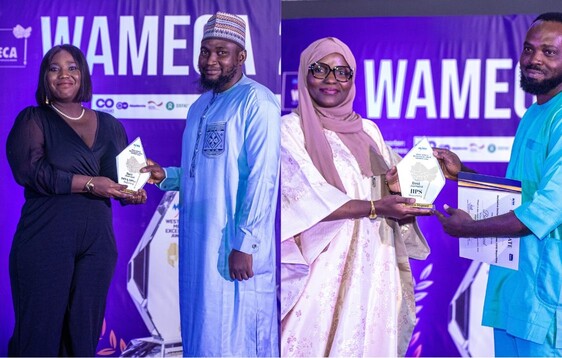


A story on Digital Public Infrastructure (DPI) in Nigeria, which was investigated and published with a funding grant from the Media Foundation for West Africa (MFWA) has won a continental award.
‘Swipe to survive: How digital payments tackle youth unemployment in Nigeria’ – was adjudged the winner of the Feature Articles category of the 2025 Grand Prix of the Federation of African News Agencies (FAAPA). On January 29, 2026 its author, Usman Aliyu, received his award for the story at a ceremony held in Marrakech, Morocco.
Usman, a journalist with the News Agency of Nigeria had pitched the story to the MFWA after a successful completion of the maiden edition of our Fellowship on Digital Public Infrastructure which was funded by Co-Develop. He received a grant to cover groundwork for the story, which spotlights how digital payment systems in Nigeria are helping to address youth unemployment in the country.
“I am deeply grateful for the recognition. I dedicate this award to the News Agency of Nigeria (NAN) for providing the platform to tell impactful, people-centred stories, and to the Media Foundation for West Africa (MFWA) for the grant support that made this reporting possible,” Usman wrote in a social media post after receiving the award.
He described the recognition as especially meaningful, noting that it was his “first international award in over a decade of journalism.” He added that it marked a significant milestone as he became “the first anglophone reporter to win the FAAPA award at this level.”
Since its publication, the award-winning report has prompted action from Nigerian authorities, with the Federal Government expanding access to Point of Sales (PoS) machines for traders across the country.
Usman tells the MFWA that he drew on important modern reporting techniques he had learned from the Fellowship, which made the story more compelling.
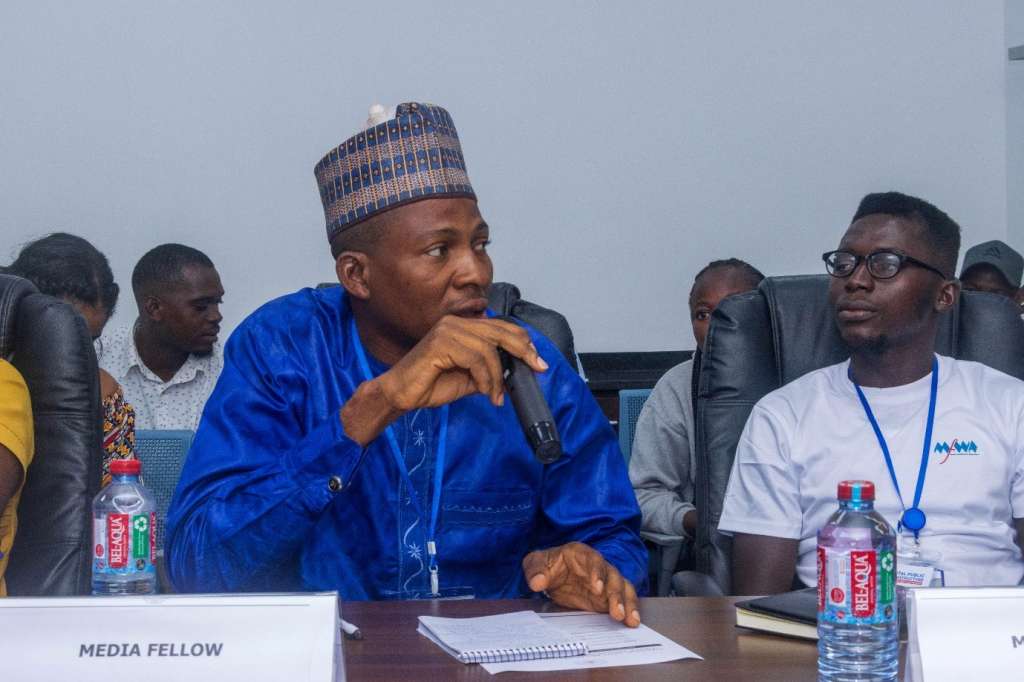
“During the Fellowship, we were taught the crucial technique of story humanisation, as the way to keep readers engaged and create a sense of ownership of the story. I used that technique extensively, deliberately telling the story through the voices of people with lived experiences,” he said.
The story combined statistics and data analyses to contextualise Nigeria’s youth unemployment problem, while employing the power of anecdotal narration to humanise the issue.
Usman also expressed gratitude to “the MFWA and Co-Develop for the opportunity to participate in the Fellowship,” saying the programme “really added on to my journalism skills and sharpened me with very modern reporting techniques.”
Since completing the maiden MFWA DPI Journalism Fellowship in 2023, Usman (now an MFWA DPI Fellowship alumnus) has gone on to produce other impactful stories such as “Data breaches and Nigerians’ right to privacy“, which brought focus to serious gaps in Nigeria’s data protection practices.
About the DPI Journalism Fellowship
The Digital Public Infrastructure (DPI) Journalism Fellowship is a flagship initiative of the Media Foundation for West Africa (MFWA), implemented in partnership with and with funding support from Co-Develop.
The Fellowship trains journalists across West Africa to understand, investigate, and report on the region’s digital public infrastructure transformation. Fellows learn to produce evidence-based stories that raise public awareness, drive accountability, promote inclusivity, and encourage active participation in digital innovations.
Since its inception in 2023, the DPI Journalism Fellowship has trained 80 journalists from 10 West African countries. Collectively, the DPI Fellows have produced over 370 stories on issues of digital IDs, digital payment systems, data exchanges and other digital transformative processes.
Through the Fellowship, MFWA and its partners are nurturing journalists who contribute to ensuring that digital progress benefits everyone and advances good governance across the region.